
How to Write a Shift Note That Actually Stands Up in an Audit
A shift note is evidence. This guide covers what NDIS auditors look for, what workers commonly get wrong, and what a valid shift note must include.
Watch the walkthrough
 0:28
0:28Watch
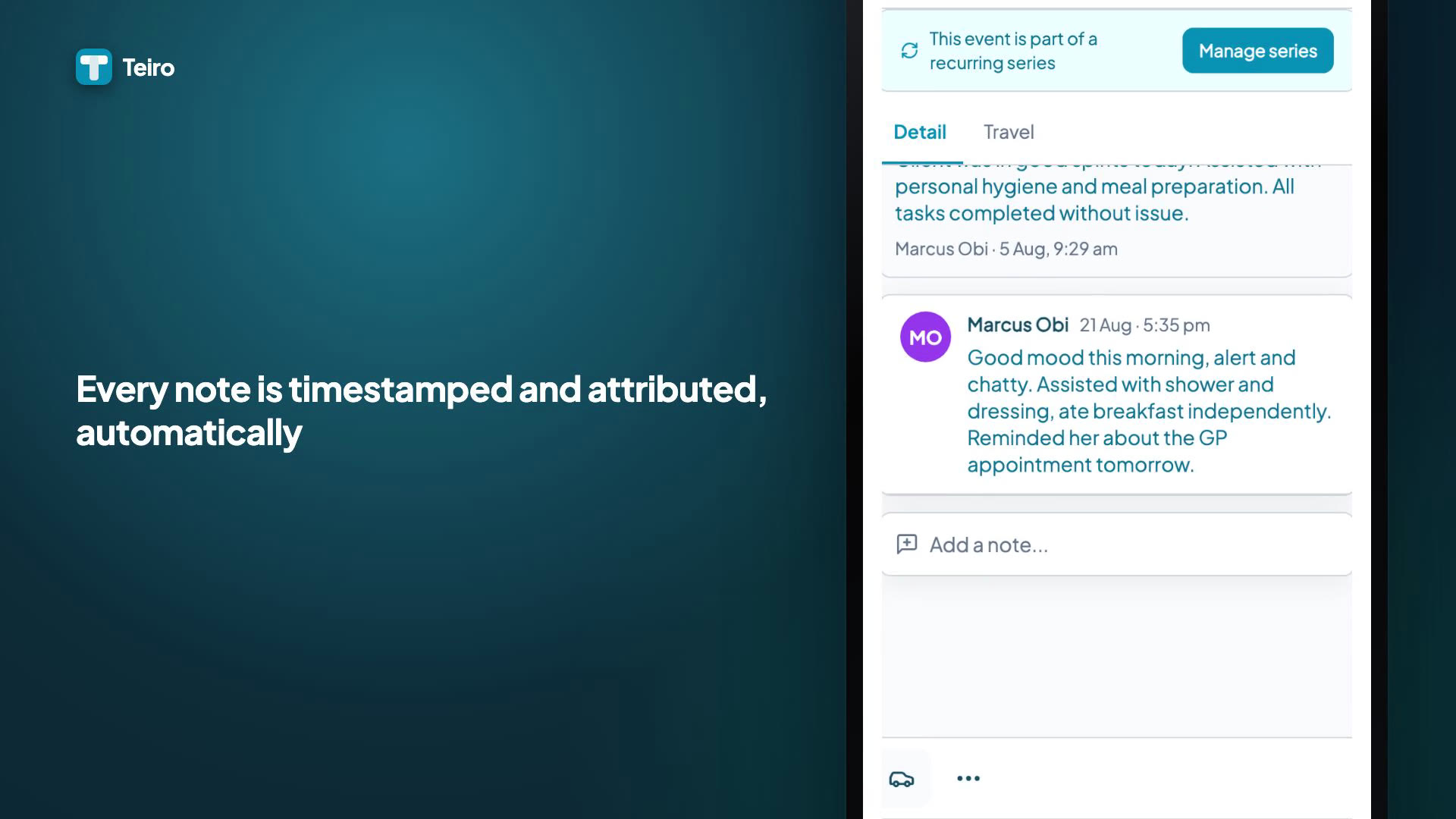
Writing a Progress Note After a Visit
How a support worker writes an NDIS or aged care progress note in Teiro straight from the visit record: seeing the client's note history, a full-screen composer, and a save that timestamps and attributes the note automatically.
Watch the walkthrough
What a valid shift note must include
Every shift note should answer six questions.
1. When did the shift happen? Date and time -- both start and end. Not "morning shift" or "afternoon." Actual times. If the shift ran 9:00am to 11:30am, write that.
2. What support was delivered? Describe what you actually did. Specific activities: personal care, meal preparation, community access (where, what activity), medication prompting, domestic assistance. The level of detail should match the complexity of the support.
3. How did the participant respond? This is where most notes fall short. Auditors want to see that you observed the participant, not just completed tasks. Were they engaged? Tired? Distressed? Did they need prompting? Did they do more independently than usual? One sentence is enough if it is specific.
4. Were there any incidents, concerns, or changes? If anything happened outside the normal run of the shift -- a fall, a medication refusal, a behavioural incident, a change in the participant's condition -- it belongs in the note.
5. Does the note connect to the participant's goals? NDIS supports are funded to work toward specific outcomes. A note that mentions the participant's goals ("worked on independent meal preparation as per goal in care plan") is stronger than one that does not.
6. Who wrote it? The worker's name and signature (or digital equivalent). The note needs to be attributable to a specific person.
What auditors actually look for
Auditors are looking for three things.
Contemporaneous records. Notes written at the time of the shift, not retrospectively. If a note was written three days after the shift, that is visible in the metadata and it raises questions.
Consistency with the service agreement. If the participant's plan funds community access and every note describes domestic assistance, that is a red flag. The note should describe support that matches what was claimed.
Evidence of person-centred practice. The participant should appear in the note as a person, not a task list. Auditors notice when notes read like a checklist with no mention of the actual human involved.
Common mistakes
Vague language. "Supported client with daily tasks" tells an auditor nothing about what was done or why. "Assisted Marcus with showering, dressing, and preparing breakfast. Marcus required verbal prompting for each step and completed dressing independently." is evidence.
Missing times. Start and end times are not optional. They are how claims are verified. A note without times cannot be matched to a billing record.
No reference to the participant's response. The worker was there. The note should reflect what they observed. If it does not, it looks like the note was written without the worker being present.
Boilerplate copy-paste. Notes that are identical shift to shift suggest they are not genuine records. Even if every shift is routine, there will be small variations. Write them.
Noting incidents elsewhere but not in the shift note. If an incident report was filed, a brief reference belongs in the shift note too. "Participant had a fall at approximately 10:15am. Incident report completed." The shift note and the incident report should cross-reference each other.
Good versus bad, side by side
Bad: > Good shift today. Client was happy and we did some activities. No issues.
Why it fails: No times. No description of what activities. No participant response. Could have been written by anyone, for any shift, for any client.
Good: > Shift 9:00am -- 11:30am. Assisted Diane with morning personal care (showering, dressing). Diane required moderate physical assistance with showering and was able to dress independently with verbal cues. We then drove to the Botanic Gardens for a walk (approx. 45 mins). Diane was engaged and in good spirits, initiated conversation about the gardens. Returned home, prepared and ate lunch together. Diane ate well. No incidents or concerns. Support delivered consistent with community access goal in care plan.
Why it works: Times present. Specific activities named. Participant response observed and recorded. Goal referenced. Auditor can match it to the service agreement and the claim.
In Teiro
Teiro's shift note fields prompt for each required element -- start/end time, support delivered, participant response, and any incidents. Notes are auto-attached to the participant's record with a timestamp and the worker's name. If an incident is flagged during the shift, it links through to the incident report automatically.
The note cannot be submitted without the required fields, which means workers cannot accidentally submit an incomplete record.
Book a demo to see how Teiro handles shift documentation, or start for free -- free for organisations with 5 or fewer active users.
Related articles
Submitting incident reports
Report incidents, near misses, or safeguarding concerns directly from the app.
NDIS Audit Preparation: The Twelve Documents You Will Be Asked For
A practical checklist of every document category NDIS auditors request, what they are checking for, and where providers commonly fall short.
Audit trails and activity history
Every change in Teiro is logged — who changed what, and when.