
NDIS Rostering
NDIS rostering software built for how disability support actually works.
Teiro’s scheduling board shows availability, NDIS Worker Screening status, qualifications, and participant history in one view. Assign shifts, catch SCHADS conflicts, and notify carers when you make the change.
Every shift maps to a support category and NDIS line item at the point of rostering. Plan-managed, NDIA-managed, and self-managed participants are visible on the board. When the shift is delivered, the billing record is already structured.
Running a small team? Free for under 5 users - no credit card, no time limit.
Who's available, qualified, and cleared. On one screen.
Availability, NDIS Worker Screening status, qualifications, and participant history visible together when you're filling a shift. Your coordinators make one decision, not five.
Conflicts caught before they're confirmed
Teiro flags double-bookings, expired credentials, and support ratio gaps before you publish the roster. Not after a carer shows up unprepared.
Participant continuity tracked automatically
Teiro records which carers have worked with each participant. When you're filling a gap, continuity of care is a filter, not something you have to remember to check.
NDIS line items mapped to shifts at rostering
Each shift maps to a support category and NDIS line item. When the shift is delivered, the billing record is already structured. No reconciling the roster against the price guide after the fact.
Demo video
A week of care on one board
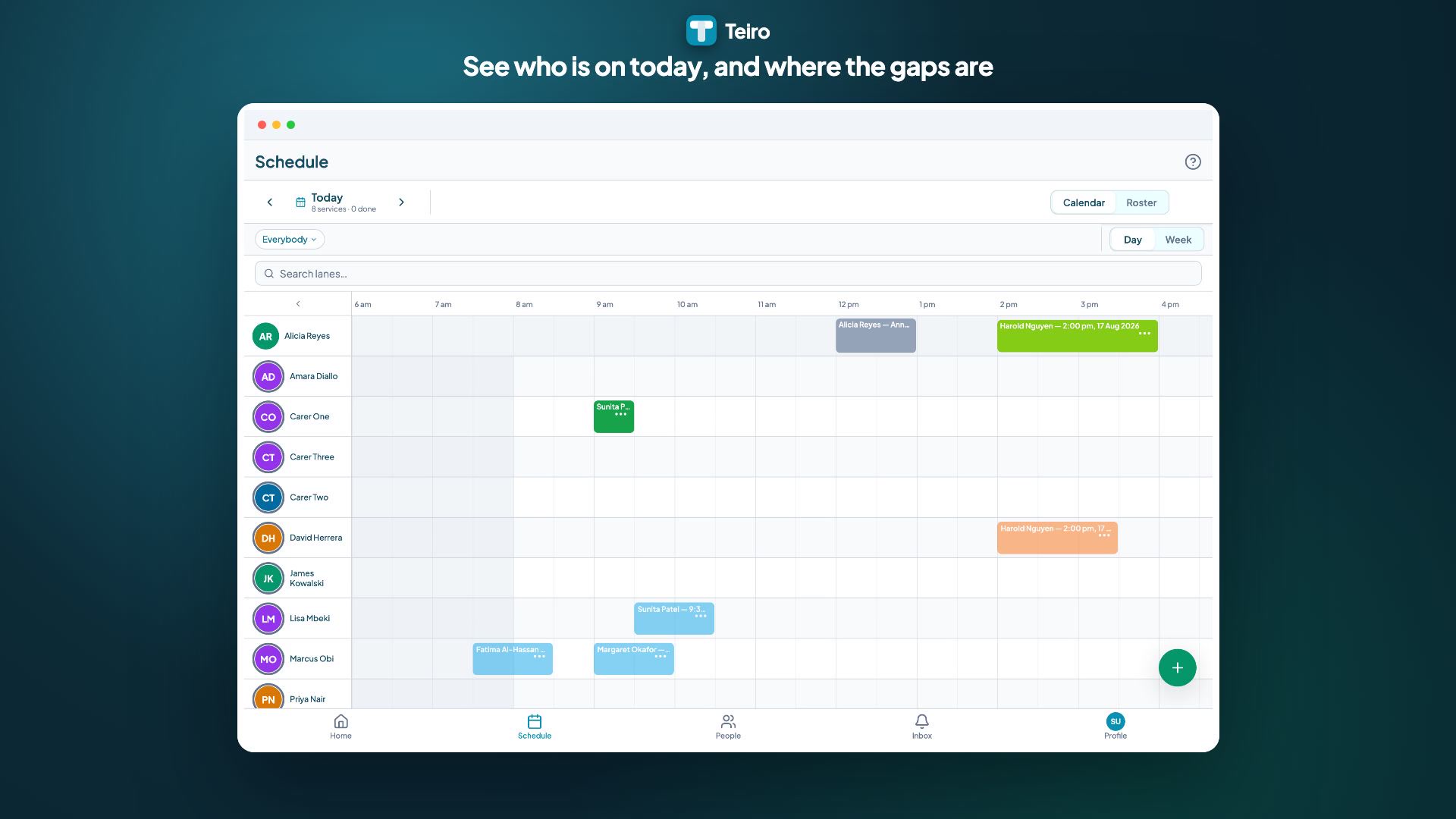
A tour of the scheduling board as a care coordinator sees it: a whole week of care at a glance, reading a single day to see who is on and where the gaps are, assigning a worker from the availability panel, and moving a shift with the change visible to the whole team immediately.
 0:29
0:29Watch
Using the Scheduling Board as a Care Coordinator
A tour of the Teiro scheduling board: a week of care at a glance, seeing who is on and where the gaps are, assigning a worker from the availability panel, and moving a shift so the whole team sees it immediately.
Watch the walkthrough
The weekly scheduling board: worker lanes, assigned visits, and any gaps that still need filling.
How it works
The whole roster. One screen.
The scheduling board gives your coordination team a live view of every shift across the week, colour-coded by status, stacked by carer, filterable by team, location, or participant. Plan-managed, NDIA-managed, and self-managed participants are distinguished on the board so your coordinators know the billing pathway for every shift without opening a separate record.
NDIS Worker Screening and qualifications at point of assignment.
When you assign a carer to a shift, Teiro checks their NDIS Worker Screening Check clearance status alongside their qualifications and availability. A carer whose clearance is expired is excluded from suggestions for regulated support roles before you even see the list. High-intensity supports are flagged and the required competencies are checked at the same step.
SCHADS Award rates calculated at rostering.
Teiro knows the SCHADS Award. Penalty rates for broken shifts, sleepover active time, Saturday and Sunday work, and public holidays are calculated at the rostering layer. Casuals on a public holiday rate at 275% (loading embedded), not 250% plus loading on top. The cost of a shift is visible before you confirm it, not when payroll runs.
Support ratios and participant preferences enforced.
Configure Supported Independent Living (SIL) shifts and shared support arrangements requiring 2:1 or 3:1 staffing. Participant exclusion lists and carer preferences are honoured at assignment. If a participant has documented support requirements that affect who can work with them, those requirements are applied at the scheduling layer, not left to coordinators to remember.
NDIS line item and support category mapping.
Each shift type maps to a support category and line item from the NDIS Pricing Arrangements. When a shift is delivered and verified, the claim record is already structured against the correct line item. Short-notice cancellation claim lines are generated automatically using the relevant cancellation support item codes in the NDIS Pricing Arrangements when a cancellation meets the NDIS criteria.
Recurring jobs without the overhead.
Set up a standing roster for participants with regular schedules. Changes to a standing arrangement generate an approval workflow so nothing moves without the right person signing off. The change is logged against the participant record.
An unassigned shift can be offered, not just chased.
When a service is unassigned, Offer to team sits alongside the usual candidate list in the Assign Worker panel. Send it to the client's regular team, their preferred carers, or everyone eligible, and see an audience preview, how many carers are eligible, how many are already booked, how many are excluded, before anything goes out.
What this looks like at 6am when someone calls in sick
It’s Monday morning. A carer calls in sick at 6 am with two SIL participants scheduled from 9 am. One participant has high-intensity support needs and a list of three carers they’ve documented as preferred. In a spreadsheet operation, this sets off a chain of calls, texts, and WhatsApp messages that can run for an hour, and produces no record of how the shift was covered.
In Teiro, the coordinator opens the scheduling board, sees the gap flagged, and filters for available carers who have previously worked with both participants, whose NDIS Worker Screening Check is current, and who hold the required high-intensity competency. Three names appear. A push notification goes to all three directly from the board. The first to confirm gets the shift. Total time: under five minutes. The substitution is logged against both participant records, and the shift stays mapped to the correct NDIS line item.
With more runway than a 6am call-in, the same gap can be offered to a tier of carers instead of assigned directly: the client’s regular team, their preferred carers, or everyone eligible, with an audience preview showing exactly how many carers will actually see it before anything sends.
The same logic applies to building a new roster from scratch. When you’re scheduling a participant with a complex support plan, 2:1 ratio requirements, and specific carer continuity preferences, Teiro shows only the carers who meet all the criteria. You’re choosing from a filtered list. The compliance check has already been done.
For operations managers overseeing rostering across multiple service streams, the board provides a single view of the week without switching between systems. Shift status, check-in confirmation, SCHADS cost calculations, and open gaps are visible together. See how compliance tracking integrates with rostering to prevent unqualified assignments before they happen.
Why generic rostering tools fall short in NDIS care
Most rostering software was built for hospitality, retail, or construction. The primary scheduling variable in those industries is hours and location. NDIS care rostering involves a different set of constraints entirely: NDIS Worker Screening Check currency, mandatory training expiry, support ratios for participants with complex needs, SCHADS Award compliance across broken shifts and sleepovers, support category and line item mapping per shift, participant continuity preferences, and the difference between plan-managed, NDIA-managed, and self-managed funding.
Generic tools require workarounds for all of this. SCHADS broken shifts and sleepover active time calculations are particularly prone to error when done outside the rostering tool. Coordinators end up maintaining a separate compliance spreadsheet, manually cross-checking screening status before confirming shifts, and keeping their own records of participant carer preferences. The tool nominally covers the roster; the coordinator manually covers everything the tool does not know about NDIS.
Teiro embeds these NDIS-specific checks into the scheduling layer itself. Screening status, qualifications, support ratios, and SCHADS penalty calculations are part of the rostering workflow, not a separate step. The result is a coordinator who spends less time on administration and more time on the things that actually require human judgement. Teiro pricing starts free for organisations with five or fewer active users.
Frequently asked questions
Does Teiro handle NDIS line item and support category mapping?
Yes. Each shift type in Teiro maps to a support category and NDIS line item from the Pricing Arrangements and Support Catalogue. When a shift is delivered and verified, the billing record is already structured against the correct line item. You are not manually matching the roster to the price guide at the end of the month.
How does Teiro handle plan-managed, NDIA-managed, and self-managed participants?
Each participant record in Teiro includes their funding management type. The board distinguishes plan-managed, NDIA-managed, and self-managed participants so your coordinators and billing team know the pathway for each shift. Billing exports are structured accordingly.
Does Teiro track service agreement budgets against rostered shifts?
Yes. Teiro tracks spending against each participant’s service agreement budget across support categories. The budget dashboard shows what has been paid, submitted, approved, delivered, and scheduled against what remains. Amber and red threshold alerts fire before a budget is overrun, not after.
Does Teiro handle NDIS short-notice cancellation claims?
Yes. When a shift is cancelled with short notice and the cancellation meets the NDIS Pricing Arrangements criteria, Teiro generates the cancellation claim line using the relevant cancellation support item codes in the NDIS Pricing Arrangements automatically. The coordinator confirms the cancellation reason; the system handles the claim structure.
Can the scheduling board filter by NDIS Worker Screening Check status?
Yes. Carers with expired or missing NDIS Worker Screening Checks are flagged automatically and excluded from assignment suggestions for regulated support roles. Your coordinators will not accidentally roster a non-compliant carer to a participant who requires a screened worker. Note: Teiro stores clearance numbers and monitors expiry dates. It does not connect to the NDIS Commission screening database directly.
Does Teiro support 2:1 and 3:1 support ratios?
Yes. Support ratios are configurable per participant or support type. Teiro flags any shift where the assigned team falls below the required ratio before the roster is published. You catch the gap before it becomes an incident, not during a review.
How does Teiro handle last-minute shift cancellations and cover requests?
When a shift needs to be covered urgently, you can send a notification from the scheduling board to a filtered list of available carers matching the participant’s requirements. Carers confirm directly from their phone. The first confirmation locks the assignment. The entire transaction is logged against the shift record and the participant profile.
Does the scheduler support recurring shifts and standing rosters?
Yes. You can set up standing rosters for participants with regular schedules. When a standing shift needs to change, an approval workflow is triggered so the change is reviewed before it takes effect. Nothing moves without a record.
Does Teiro integrate with payroll software?
Teiro handles scheduling, compliance, and NDIS billing. Shift records and carer hours are available as structured exports for your payroll system. SCHADS Award penalty rate calculations are done at the rostering layer, so the data your payroll team receives already reflects the correct rates. Direct payroll integrations are in development.
See the NDIS rostering board live
We'll show you a real roster, real conflict detection, and how line items map to shifts. Takes 30 minutes.
Free for under 5 users - no credit card, no time limit.