
Medication Management
One signature per medication. One batch, committed at once.
Teiro is a digital medication administration record for Australian NDIS and aged care providers. Support workers record a single dose or a whole time slot in one action, with an outcome and a signature for every medication and the batch committed as one atomic write. PRN medications carry their own trigger and effect, and Schedule 8 entries step up to a fresh biometric or PIN confirmation instead of a one-tap saved signature.
This is built specifically for how Australian community and aged care providers actually administer medication, including doses packed into a Webster pack or other dose administration aid, where the record still needs to show what happened to each medication in the pack, not just the pack as a whole.
Running a small team? Free for under 5 users - no credit card, no time limit.
A whole time slot recorded in one action, one signature per medication
A support worker selects everything due in a time slot and works through it in a single sheet: an outcome and a signature for each medication, then one Confirm & save commits the whole batch as one atomic write. Nothing is blurred together. A signed history per medication is what lets the record answer a specific question later, such as whether a particular medication was actually given on a particular day.
Every entry gets a signature, given or not
On a paper MAR, a carer initials every box, whether the dose was given, refused, or withheld. Teiro's digital MAR works the same way: nothing is recorded without a signature, so the record shows who made the entry and when, not just what happened.
Controlled drugs step up to a fresh biometric or PIN confirmation
Ordinary entries can use a saved signature and a single tap. Schedule 8 entries remove that shortcut: the administering carer confirms with a fresh biometric check each time, falling back to an in-app PIN on web or if biometrics fail. A witness can also be recorded, present in person, by phone, or noted as not required under the client's care plan, but the witness is optional metadata captured by the same carer, not a second sign-off: it is never a condition for saving the entry.
PRN doses carry the reason and the effect, not just the tick
A PRN medication in Teiro records what triggered the dose and what it was for, alongside how many doses have been given that day. That context sits with the entry permanently, instead of living in a support worker's memory or a separate note.
Demo video
A medication administration record, walked through
One client record: today’s doses grouped by time of day, the active medication list, a whole time slot recorded in one batch with a separate signature for each medication in it, and a PRN dose recorded with what triggered it and what it was for.
 0:36
0:36Watch
A Medication Administration Record Walkthrough in Teiro
A short walkthrough of a medication administration record in Teiro: today's doses grouped by time of day, the client's active medication list, a whole time slot recorded in one batch with a separate signature per medication, and a PRN dose recorded with its trigger and effect.
Watch the walkthrough
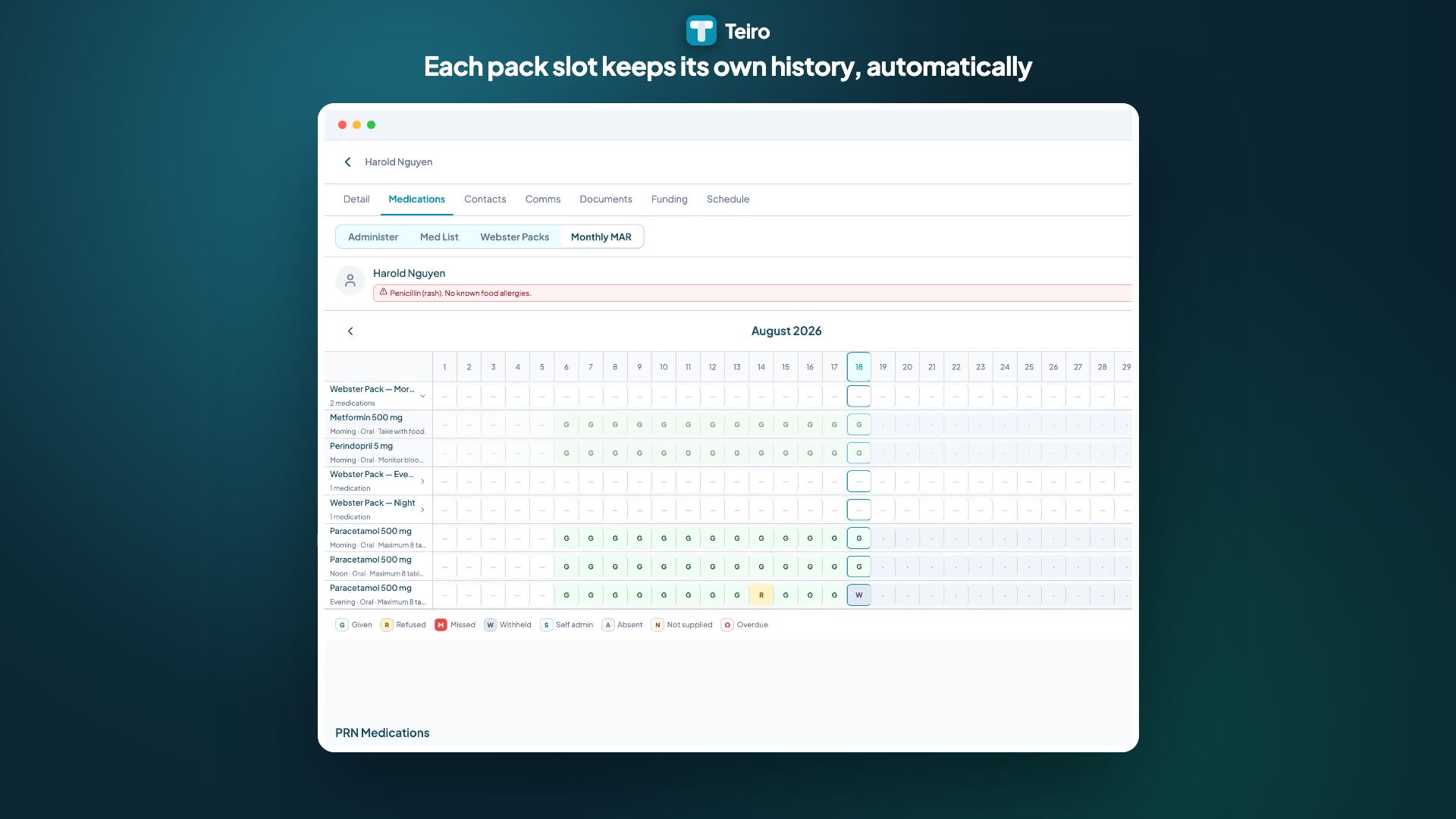
The monthly MAR: every medication against every day, grouped under the dose administration aid pocket it is packed into, with its own signed outcome in each cell.
How it works
See the month, then see today
The monthly MAR view lays out every client's medications across the month in a grid, the shape a coordinator or an auditor expects from a medication administration record. The daily view groups the same medications by time of day, morning through overnight, which is the view a support worker actually works from during a visit.
The daily view a support worker works from: every medication grouped by time of day, with the client's allergy note pinned above it.
Record a single dose or a batch, in one action
A support worker can administer one medication at a time, or select everything due in that time slot and work through it in a single sheet, one outcome and one signature per medication. Teiro records each outcome as given, refused, withheld, self-administered, not supplied, or missed. A dose that has already been recorded cannot be recorded again for the same medication and time slot, so a support worker cannot accidentally double up.
The whole batch commits together, but every medication keeps its own signature
Confirm & save only unlocks once every medication in the batch has been signed, and the batch then commits as one atomic write rather than one slow line at a time. That matters for medications packed into a dose administration aid (a Webster pack, in common usage): a support worker still administers the pocket in a single pass through the sheet, but the record keeps a separate signed entry for each medication that was in it. If two carers, or a stale list on the device, ever try to record the same medication and time slot twice, Teiro reports exactly what was newly recorded and what had already been saved, rather than a flat count that could overstate what actually happened.
PRN medications carry their own trigger and effect
Each PRN medication is set up with what it is for and what a support worker should watch for. When it is given, the entry records the trigger and the effect, and the day's dose count is visible against the medication so a support worker and a reviewing coordinator can both see how many times it has been given that day.
Schedule 8 and other controlled drugs get their own handling
Medications carry a schedule classification, general, S4, S4D, or S8. An S8 entry requires a fresh biometric confirmation each time, falling back to an in-app PIN on web or where biometrics are not available; the saved one-tap signature shortcut is not offered. A witness can also be recorded, present in person, by phone, or noted as not required under the client's care plan, and every controlled drug entry creates its own audit activity record. The witness is optional metadata captured by the same carer; it is never a condition for saving the entry, on any schedule.
A Schedule 8 entry will not take a saved one-tap signature: the signature field is marked Biometric required and the administering carer confirms with a fresh biometric check, or a PIN where biometrics are not available.
A refused or missed dose does not just disappear
Medication prompts, the softer step before an outright refusal or an administration, move through a workflow from recorded to flagged to reviewed. A refused dose, an inability to take it, or a partially taken dose auto-flags for review, and a coordinator or clinical lead gets a notification rather than finding out from a shift note days later.
Why this is different
A whole time slot in one pass, without blurring what happened to each medication
A large share of Australian community and aged care clients have their regular medications packed into a Webster pack, a dose administration aid, by a pharmacy: one pocket per time slot, several medications to a pocket. A support worker administering that pocket does it in one pass, but the record still needs to answer a much sharper question than “was the pocket given”: did this specific client get their Perindopril on Tuesday, when the Metformin in the same pocket was refused.
Teiro’s administer sheet lets a worker select everything due in a time slot and record an outcome and a signature for each medication in it, then save the whole batch as one atomic write. One pass through the sheet, one save, and a record that still distinguishes every medication in the slot rather than treating the pocket as a single event.
What the record has to show, and what Teiro does not do
Teiro is medication administration software, not a clinical decision-making system. It gives every dose a time-stamped, signed record: who administered it, when, and what the outcome was, alongside the schedule classification and, for controlled drugs, an optional witness and its own audit trail entry. That record is what a coordinator, a pharmacist, or an auditor needs to see that medication was managed the way it was supposed to be.
What it does not do: it does not decide who is legally permitted to administer a medication in your state or territory, it does not maintain a Schedule 8 drug register or run stock balance reconciliation, and it does not enforce a maximum PRN dose in a 24-hour period on your support worker’s behalf. Those questions sit with your organisation’s own policies, your pharmacist, and your state or territory regulator. See who can administer medication in NDIS and aged care for how that question actually gets answered.
Medication management also sits alongside your organisation’s obligations under the Aged Care Quality Standards and the NDIS Practice Standards. Teiro gives you the record those obligations require you to be able to produce; it does not replace your policies or your clinical governance.
PRN medication and restrictive practices
A PRN medication given to influence a person’s behaviour, rather than to treat a diagnosed condition, can be a chemical restraint and a restrictive practice. Teiro records what a PRN dose was given for and its effect, which is the documentation a reviewer needs, but whether a specific PRN use is a restrictive practice, and whether its use is reportable, is a clinical and regulatory question, not a software one. If you support aged care clients under a behaviour support plan, see restrictive practices and SIRS: what you need to report.
Frequently asked questions
Is there medication management software for NDIS and aged care providers in Australia?
Yes. Teiro is care workforce software for Australian NDIS and aged care providers with a built-in digital medication administration record: monthly and daily MAR views, single and batch dose administration with a signature per medication, PRN tracking, and a biometric or PIN step-up for controlled drug entries.
Does Teiro support Webster packs?
Yes. A support worker administering a Webster pack (a dose administration aid) selects everything due in that pocket and records an outcome and a signature for each medication in it in one pass through the administer sheet, then the whole batch commits together as a single atomic write. There is no single shared signature standing in for the whole pocket; the record keeps a separate signed history for every medication that was packed into it.
Does every medication entry need a signature, even if the dose was not given?
Yes. Every entry, whether the outcome is given, refused, withheld, self-administered, not supplied, or missed, is signed. The signature confirms who made the entry and when, the same way a carer initials every box on a paper MAR, not just the boxes where a dose was given.
How does Teiro handle Schedule 8 (S8) and other controlled drugs?
Medications carry a schedule classification (general, S4, S4D, or S8). An S8 entry requires a fresh biometric confirmation each time rather than a one-tap saved signature, falling back to an in-app PIN where biometrics are not available. A witness can be recorded (present in person, by phone, or noted as not required under the client’s care plan), but the witness is optional metadata captured by the same carer; it is never a condition for saving the entry. Every controlled drug entry also creates its own audit trail record. Teiro does not maintain a Schedule 8 register or run stock reconciliation.
Does Teiro stop a support worker giving a PRN dose too soon after the last one?
No. Teiro records how many times a PRN medication has been given that day and what each dose was for, so a support worker and a reviewing coordinator can see the day’s history, but it does not block or enforce a minimum interval or a maximum dose in a 24-hour period. That judgement stays with the support worker, the medication management plan, and your clinical policies.
Can a medication entry be backdated?
Only within a short window: an entry can be recorded for today or, at the latest, the day before. It cannot be recorded ahead of time and it cannot be used to backfill a record from further in the past. This keeps the record close to when the dose actually happened rather than being reconstructed after the fact.
Who can record a medication administration in Teiro?
Recording is permission-gated to roles that actually deliver or oversee support: carer, team leader, scheduler, coordinator, and admin roles. Billing-only roles cannot record a medication administration. Who is legally permitted to administer a specific medication is a separate, state and territory-specific question that Teiro does not decide; see who can administer medication in NDIS and aged care.
How is this different from competency tracking or Medication Administration as a credential?
Competency tracking covers whether a worker holds a medication administration credential and enforces it at the point of assignment. This page covers what happens once a worker is on the visit: the actual medication administration record, dose by dose. The two work together, one checks who is qualified to be there, the other is the record of what happened while they were.
Related guides and features
Webster packs and dose administration aids: what the record has to show
What a dose administration aid changes about administering medication, and what still has to be documented for each medication packed into it.
What a medication administration record must contain
The elements an auditor or pharmacist expects to see in a compliant MAR.
Who can administer medication in NDIS and aged care
Why this is a state and territory legislative question, not a national rule, and how providers document it.
Competency tracking
Track the medication administration credential itself and enforce it at shift assignment.
Compliance and qualification tracking
The wider credential register and audit-ready reporting medication sits alongside.
Restrictive practices and SIRS
When a PRN psychotropic dose is a restrictive practice, and when its use is reportable.
See the medication record live
We'll walk through the MAR, PRN tracking, controlled drug handling, and batch dose administration with your own client data.
Free for under 5 users - no credit card, no time limit.