
What a Medication Administration Record Must Contain in Australia
A medication administration record exists to answer one question after the fact: what happened. Here is what an auditor, a pharmacist, or a coordinator expects a MAR to contain, and why the reason field is never optional.
The short answer
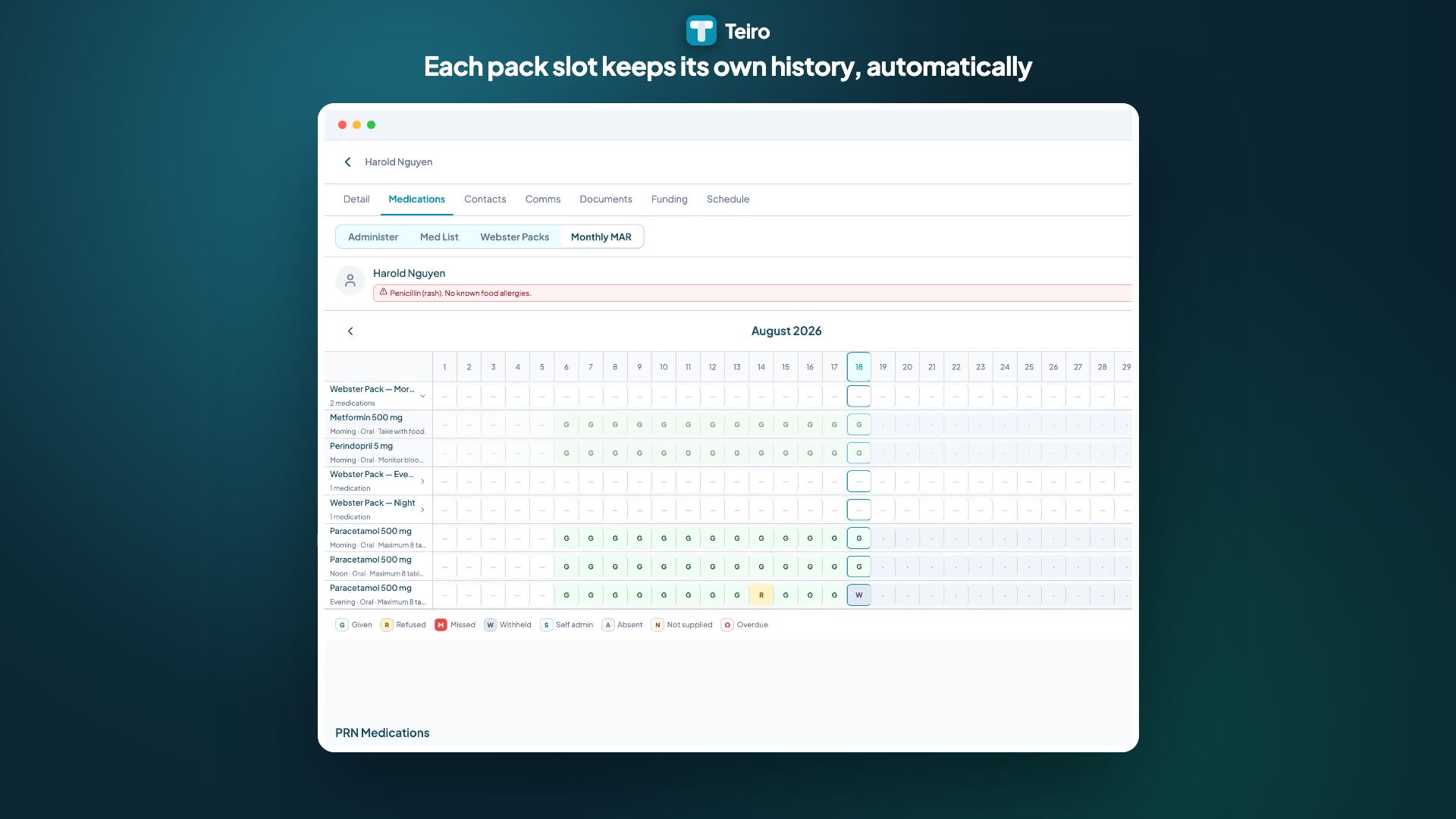
A medication administration record, or MAR, is the document that shows, for every scheduled dose, what medication was due, whether it was given, and who recorded it. In Teiro, the care management platform used by Australian NDIS and aged care providers, that record exists as a monthly grid view and a daily view grouped by time of day, and every entry is signed regardless of the outcome. This guide covers what a MAR needs to contain to actually stand up to scrutiny, not just what a template looks like.
Watch the walkthrough
A medication administration record in Teiro shows every scheduled dose grouped by time of day, the client's active medications, and a Webster pack pocket where each packed medication still keeps its own independently signed history. A PRN dose is recorded separately, with what prompted it and what effect it had.
 0:36
0:36Watch
A Medication Administration Record Walkthrough in Teiro
A short walkthrough of a medication administration record in Teiro: today's doses grouped by time of day, the client's active medication list, a whole time slot recorded in one batch with a separate signature per medication, and a PRN dose recorded with its trigger and effect.
Watch the walkthrough
Today's doses grouped by time of day, the active medication list, a Webster pack pocket showing each medication's own signed history, and a PRN dose recorded with its trigger and effect.
The steps below cover the same ground in writing, including what still has to be true regardless of whether a dose comes from a pack or from original packaging.
The core elements of a MAR
Whatever system produces it, a medication administration record needs to show, for each scheduled dose:
- Who the client is. Unambiguous client identification against every entry, not just at the top of the page.
- What the medication is, including the strength and form, not just a brand name that could refer to more than one product.
- The scheduled time. When the dose was due, not just the day.
- The outcome. Given, refused, withheld, self-administered, not supplied, or missed. A blank entry is not a record of anything; it is a gap.
- Who recorded it, with a signature. On a paper MAR this is an initial in the box. On a digital MAR it is a signed entry tied to a specific user. Either way, an unsigned entry does not count as documented.
- The medication's schedule classification, general, S4, S4D, or S8, because controlled drugs carry additional handling and audit expectations.
- A reason wherever the outcome is not "given". A refused, withheld, or missed dose without a reason tells a reviewer that something happened but not what to do about it. See below for why this field is never optional.
Why the reason field is never optional
"Refused" on its own is not useful information. Refused because the client said no and was capable of making that decision is a very different situation to refused because the client was too drowsy to safely swallow a tablet, and both are different again from a dose withheld on a GP's verbal instruction pending review. Each of those needs a different next step, and none of them is visible from the word "refused" alone.
A MAR that records the outcome without the reason answers "did the dose go in" but not "should someone be worried." That second question is the one a coordinator, a family member, or a reviewing nurse actually needs answered, and it is why a reason field attached to any non-given outcome should never be treated as optional, in any system.
PRN medications need more than the other rows
A PRN (as-needed) medication cannot be documented the same way as a scheduled one, because there is no fixed time to check it against. A PRN entry on a proper MAR needs, in addition to the elements above:
- What triggered the dose. The symptom or situation that led to it being given.
- The effect. Whether it worked, part-worked, or made no difference.
- How many doses have been given in the relevant period. Visible against the medication, not reconstructed from scattered entries.
What "prompting," "assisting," and "administering" mean for the record
These three are different actions and the record should distinguish them, because they carry different levels of responsibility:
- Prompting is reminding a client it is time for their medication and that it is available, without physically handling it.
- Assisting is helping a client take their own medication, for example opening a packet or handing over a glass of water, while the client remains the one taking it.
- Administering is a support worker giving the medication directly.
Which of these is happening for a given client and medication should be set out in their medication management plan, and the record of what actually occurred should be consistent with it. Getting this distinction blurred in the documentation is one of the more common gaps reviewers find.
Retention and audit readiness
How long a medication record needs to be kept, and exactly what a specific state health department or the NDIS Commission expects to see during an audit, are questions that sit with your own regulatory obligations and your organisation's policies rather than with this guide. For the broader picture of what an NDIS audit asks for, including where medication records fit alongside qualification records, service agreements, and incident reports, see NDIS audit preparation: the twelve documents you will be asked for.
How Teiro structures this
Teiro's MAR gives every client a monthly grid view for the shape a coordinator or an auditor expects, and a daily view grouped by time of day for the view a support worker actually works from on a visit. Every entry, given or not, is signed. PRN medications carry their trigger and effect on each entry. Controlled drug entries step up to a fresh biometric or PIN confirmation rather than a saved one-tap signature. See the full medication management feature page, and how Webster pack medications are recorded one entry at a time alongside every other medication.
Frequently asked questions
What is the difference between a MAR and a medication chart?
In Australian usage they generally mean the same thing: the ongoing record of what was administered against what was scheduled. "MAR chart," a term used in the UK, is not standard Australian terminology; Australian providers more commonly say "medication chart" or "medication administration record."
Does a missed dose need to be recorded, even if it was an accident?
Yes. A missed dose is still an outcome, and it needs a signed entry with a reason, the same as a refused or withheld dose. An unrecorded missed dose looks, on the record, exactly like a dose that never should have happened in the first place, which is a worse position for a provider to be in than an honestly recorded miss.
Do PRN and scheduled medications need to be on the same record?
They should sit in the same overall medication record for the client, but a PRN entry needs to carry its own trigger and effect, which a scheduled dose does not. Keeping them in one place, rather than a scheduled MAR in one system and a PRN log in another, is what lets a reviewer see the full picture for a client at once.
Who should be able to see medication records versus record them?
That depends on your organisation's own role structure and clinical governance, but as a general principle, the ability to record a medication administration should be limited to roles that actually deliver or directly oversee support, not extended to every role in the system, such as billing-only roles that have no involvement in care delivery.
Want to see the MAR running with your own client and medication data? Book a demo or start free with up to five active users.