
Communications
Message clients without personal phones.
Support workers and coordinators contact clients through Teiro, not their own mobile. One platform number sits in the middle - nobody sees the other person’s real number, and every message writes itself to the client record. No screenshots to chase for evidence. No personal number to hand back when someone leaves.
Running a small team? Free for under 5 users - no credit card, no time limit.
Nobody hands over a personal number
Support workers message clients from inside the Teiro app. Clients reply by ordinary SMS to one platform number. Neither side ever sees the other's mobile number.
Every message is on the record, automatically
There's no opting out of logging - each message writes to the client's timeline the moment it sends or arrives. Coordinators see the full exchange without being copied in.
A worker leaving doesn't take the contact book with them
Because the carer's own mobile is never part of the conversation, a support worker who leaves your organisation leaves with nothing - no client numbers saved in their phone, no thread they can keep messaging from.
Even staff who can see the number are asked to think twice
A client's phone number is masked by default on their record. Revealing it is a deliberate action with a warning and its own audit entry - not a number sitting in plain view for anyone to note down.
Demo video
A support worker messaging a client from a visit
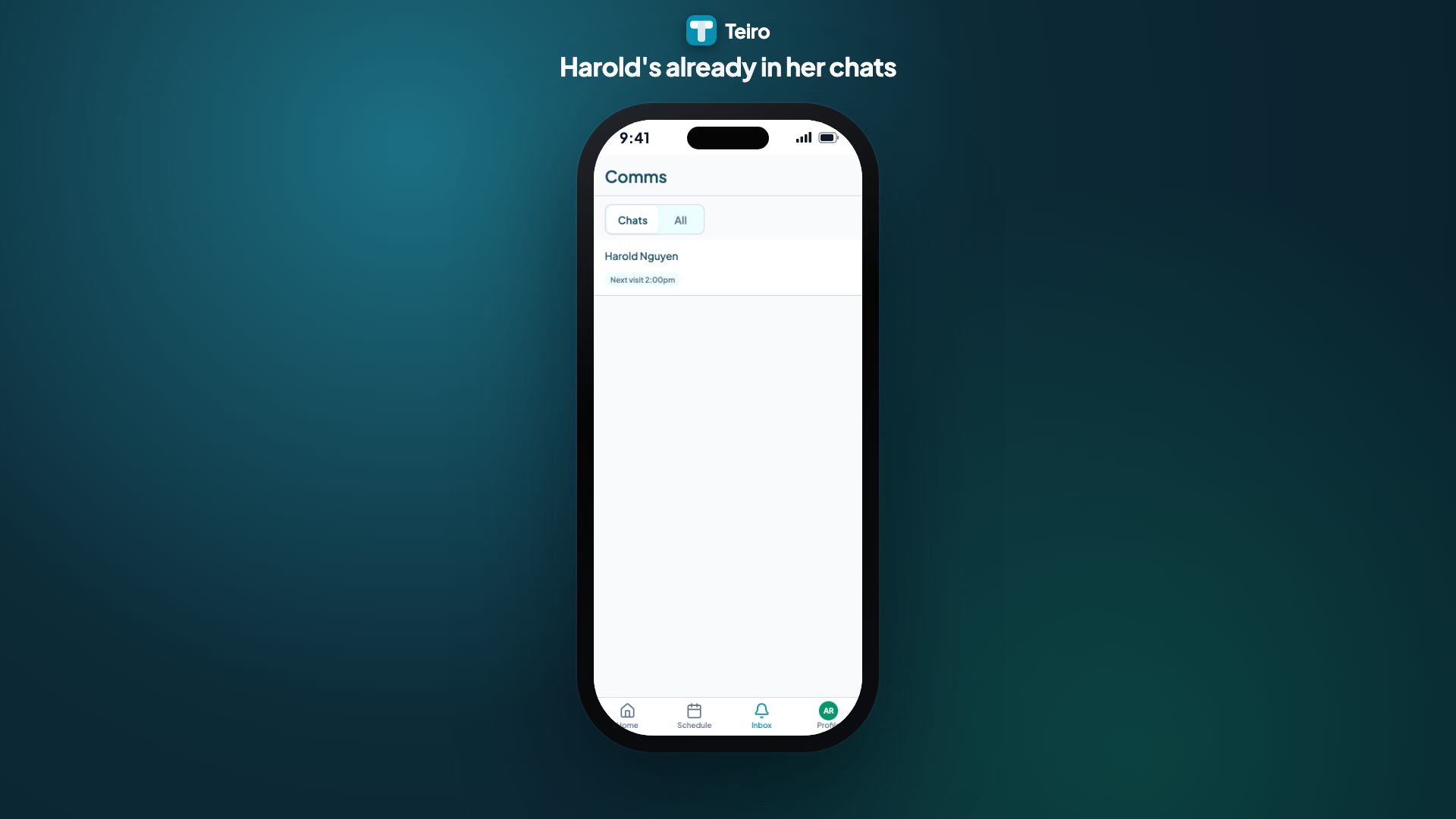
A support worker running late messages the client straight from the app, with neither phone number changing hands. The channel is already open because she is rostered onto the visit, the client replies by ordinary SMS, and she checks in on arrival.
 0:29
0:29Watch
How a Support Worker Messages a Client in Teiro
A support worker running late messages the client from the app, without either phone number changing hands. The channel is already open because she is rostered on, the client replies by plain SMS, and she checks in on arrival.
Watch the walkthrough
Coordinators start a conversation straight from the client record - no separate app, no personal number.
How it works
One platform number, not a personal one.
A single Teiro SMS number handles inbound and outbound messages across every organisation on the platform. Your organisation's name goes in the message itself, not in a dedicated number - so there's no per-org number to buy, lose, or hand over.
Message from the client record or from the visit.
A coordinator can start a conversation directly from the client record - the paper-plane icon opens a composer that picks the right recipient (the client themselves, or a nominated family member or representative) before a word is typed. A support worker messages from inside their visit, scoped to that client and that shift.
Scoped to the visit, not an always-on line.
The channel is for day-of logistics - running late, door codes, "I'm outside" - not general chat. It opens around an active or upcoming visit and closes when the assignment ends. Outside that window, an inbound message is redirected to your organisation's on-call line rather than sitting unread on an off-shift worker's phone.
Call log notes, on the record.
The rest of the comms hub is unchanged: log a note against a shift or client record after a phone call, so what was said is on the record rather than in someone's memory.
Picking a recipient - the client, or a family member with a recorded reason to be the contact point - before a message can be typed.
The full exchange, on the client record, the moment it happens - not reconstructed after the fact.
Even a staff member with full access to the record sees the number masked by default. Revealing it is a deliberate, logged action.
What happens when carers text from their own phone
A support worker is running late. The fastest thing to do is text the client directly - so they save the client’s number, or the client’s family member’s number, and it happens on their personal phone from then on. It works, in the moment. But now a client’s mobile number lives in a support worker’s contacts app, outside any system your organisation controls. There is no record of what was said. If that worker leaves, they leave with the number still in their phone. If a family member later asks “who has my mother’s mobile number,” the honest answer is: nobody in the office actually knows.
In Teiro, the same “running 10 minutes late” message goes from inside the carer’s app to the client’s ordinary phone, through one platform number. The carer never sees the client’s number and the client never sees the carer’s. A coordinator can also start the conversation directly from the client record, choosing the client or a nominated family contact before typing a word. Either way, the message lands on the client’s timeline automatically - visible to any coordinator with access, not sitting in one person’s pocket.
The channel is scoped to the visit on purpose: it opens around an active or upcoming shift and closes when the assignment ends. It is not a standing line between one carer and one client that stays open indefinitely, and outside that window a message is redirected to your organisation’s on-call line rather than sitting unread on someone’s day off. See how compliance documentation links to the same client record to keep the whole picture in one place.
Why “just use WhatsApp” doesn’t hold up
Generic messaging tools - WhatsApp, personal SMS, even a shared team Slack - share the same structural problem for a care organisation: the message and the number both live outside anything the organisation controls. A text about a client’s changed support needs is a message on someone’s personal phone, not a note on a client record. When that person is on leave, changes role, or leaves the organisation altogether, the conversation history and the client’s number go with them.
Care providers are also expected to be able to show how they communicated with clients and support workers, particularly around care-plan changes, incidents, and complaints. A WhatsApp screenshot, hunted down after the fact from whichever phone happened to still have it, is a weak substitute for a record that was captured automatically at the time.
Teiro’s communications hub is built around the client record rather than around any one person’s device. Every message - the day-of SMS between a carer and a client, a coordinator’s message to a family contact, a call log note - attaches to the client, the carer, and the shift it relates to, without anyone having to remember to log it. Teiro is free for organisations with five or fewer active users.
Frequently asked questions
How does Teiro stop support workers texting clients from their personal phone?
By making the in-app option the fast option. A carer messages a client from inside their visit in the Teiro app; the client receives an ordinary SMS from Teiro’s platform number and replies to it normally. The carer’s own mobile number is never part of the exchange, so there is nothing to save into a personal contacts app in the first place.
Do carers and clients see each other’s real phone numbers?
No. The client sees a single Teiro platform number, the same one every client on the platform texts. The carer never sees the client’s number either - they read and reply inside the app. Your organisation’s coordinators can still see the client’s number on their record, since it’s the client’s own contact detail, but even there it is masked by default and revealing it is a deliberate, logged action (see below).
Is Teiro’s SMS number dedicated to our organisation?
No - Teiro uses one platform-wide number that routes inbound messages to the right client and organisation automatically, based on the client’s own phone number. Your organisation’s name appears in the message itself, so there is no separate number to buy, configure, or lose track of.
What is “guarded reveal” on a client’s phone number?
On a client record, the phone number field is masked by default (something like 04** *** 678), even for staff who have full access to the record. Tapping to reveal the full number shows a warning that the action is recorded, and creates its own entry in the record’s activity log. It nudges staff toward the logged messaging channel for routine contact, while still making the real number available when it’s genuinely needed.
What happens if a client texts outside the visit window?
Outside an active or imminent visit, the day-of-contact channel for that carer is closed, so the message never sits unread on an off-shift worker’s phone. The client instead receives an automatic reply directing them to your organisation’s own on-call line. Teiro does not route messages to emergency services - what a client should do in a genuine emergency remains your organisation’s own protocol, communicated separately.
Can we message a client’s family member instead of the client directly?
Yes. When a coordinator starts a conversation from the client record, they choose who the message is actually going to - the client themselves, or a recorded family member or representative - before typing anything. This matters for clients who can’t or don’t use a phone themselves; the conversation still lands on the client’s own timeline either way.
Is every message kept, or can staff delete them?
Messages are append-only - neither a carer nor a client can delete a message once it’s sent. If a worker’s access to a client is removed, they lose access to that conversation thread rather than keeping a personal copy of it.
Does Teiro show delivery status for SMS?
Yes. Teiro tracks delivery status for every SMS sent through the platform - sent, delivered, or failed - and surfaces that status on the message itself, with a retry option on a failed send. Carrier SMS does not support read receipts, so Teiro does not claim to show whether a recipient has opened or read a message.
Can I message my whole team at once?
Yes, but through a different feature. This page covers one-to-one messaging between a worker and a client through your organisation’s number. Messaging your whole team at once is group messaging, which reaches everyone rostered on a day, one client’s care team, or all staff, and delivers by push notification to the Teiro app rather than by SMS.
Further reading
- How Support Workers Message Clients Without Sharing Phone Numbers
- Carer-Participant Contact Without Personal Devices, and How to Keep It Audit-Ready
- Setting Up Client Messaging in Teiro
- How to Improve Carer Communication Without Adding Another App
- Care Worker Communication Apps: What Australian Providers Are Using in 2026
See it live, without handing over a phone number
We'll show you masked client messaging, the audit trail it leaves behind, and the rest of the comms hub in your demo.
Free for under 5 users - no credit card, no time limit.