GPS Check-In for NDIS Carers: Why Location Verification Matters
How GPS check-in works for NDIS support workers, why location verification improves compliance and payroll accuracy, and how Teiro does it without continuous tracking.
How GPS check-in works
GPS check-in captures the carer's location at the moment they check in to a job. That location is compared against the job address and a distance is calculated.
In Teiro, this works as follows:
- 1.The carer opens the job in the mobile app and taps Check In.
- 2.The app requests the device's current GPS coordinates.
- 3.Those coordinates are sent to the server alongside the check-in timestamp.
- 4.The system calculates the distance between the carer's recorded location and the job address.
- 5.The check-in record shows both the timestamp and the distance, visible to coordinators in the job detail view.
If a carer is 50 metres from a client's home when they check in, that's unremarkable. If they're 3 kilometres away, that's worth a look.
Coordinators see this information in the job activity feed without needing to do anything. There's no dashboard to monitor or manual cross-referencing required.
!Job detail screen in CareOS showing visit time, AI Summary section, and Documents on this job
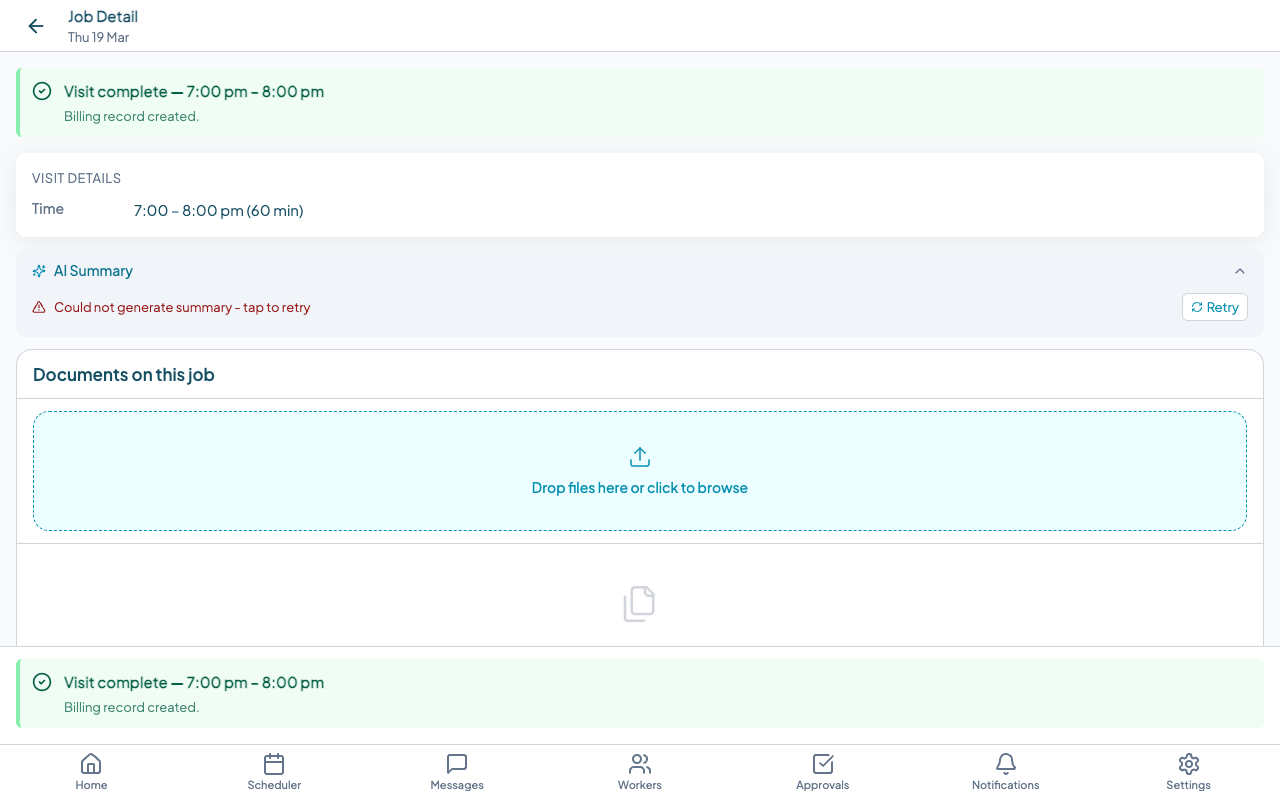
The job detail view shows the visit time window, carer notes, and the check-in record. Coordinators can review any job from the scheduler board or directly via the client record.
What GPS check-in is not
The word "tracking" makes some carers and advocates nervous, and understandably so. Continuous GPS tracking of carers throughout their day raises legitimate privacy concerns and is generally not appropriate for a workforce that works independently in clients' homes.
Teiro captures location once, at check-in, and once at check-out. It does not track carers between jobs, during a shift, or at any other time. The location data is attached to the check-in or check-out event and goes nowhere else.
This is an important distinction when communicating the feature to your carer workforce. The message is: "When you check in, we record where you are. That's it." That's a different proposition from "we know where you are all day."
Carer privacy: single-point check-in vs continuous tracking
Single-point check-in and continuous tracking are categorically different from a privacy standpoint, and your workers and their representatives are entitled to understand the difference.
Continuous GPS tracking -- building a real-time trail of a worker's location throughout their shift -- is widely regarded as disproportionate for community care settings. It creates a detailed record of movement that goes far beyond what any compliance purpose requires and raises legitimate concerns about surveillance.
Teiro records two location points per job: when the carer checks in and when they check out. No data is collected in between. There is no background location access. When the carer is not actively using the app for a check-in or check-out, no location data is captured or transmitted.
This approach satisfies the evidence requirement -- a coordinator can confirm the carer was at the right place at the right time -- without creating a surveillance record of the worker's movements.
When briefing carers on how the feature works, the clearest way to put it is: "The app records your location once when you start a job and once when you finish. Nothing in between."
Privacy Act 1988 obligations when collecting location data
Location data is personal information under the Privacy Act 1988 (Cth). Collecting GPS coordinates from workers is a collection of personal information, and the Australian Privacy Principles (APPs) apply.
For NDIS providers, the relevant obligations are:
APP 3 -- Collection of solicited personal information. You must only collect personal information that is reasonably necessary for your functions. GPS coordinates at check-in are reasonably necessary for service delivery verification and payroll accuracy. Continuous background tracking is unlikely to satisfy this test for most care providers.
APP 5 -- Notification of collection. At or before the time of collection, you must take reasonable steps to notify workers (or ensure they are aware) of: who is collecting the information, what it will be used for, whether it will be disclosed to third parties, and how they can access or correct it. In practice, this means your employment contracts, privacy policy, and staff handbook must all describe the GPS check-in feature and its purpose.
APP 6 -- Use and disclosure. Location data collected for service verification must not be repurposed without consent. You cannot, for example, use check-in location data to track whether workers are visiting friends during working hours -- that is a secondary use not reasonably related to the original purpose.
Consent in practice. While the APPs do not always require explicit consent for employee data collection (employment contracts create some implied authority), best practice is to obtain written acknowledgement from workers that they understand GPS location is recorded at check-in and check-out. Teiro's onboarding flow prompts this. For your own records, ensure your enterprise agreement or employment contracts reflect the practice.
State and territory workplace surveillance laws also apply in some jurisdictions. New South Wales, Victoria, and the ACT each have surveillance-in-the-workplace legislation that may impose additional notification requirements. If your workers are based in these states, check with your legal adviser that your disclosure practice meets the local standard as well as the federal APPs.
What Teiro's GPS check-in logs
| Field | What it captures | Who can see it | Retention |
|---|---|---|---|
| Check-in timestamp | Date and time the carer tapped Check In | Coordinator, scheduler, admin, carer | Retained with the job record |
| Check-in GPS coordinates | Latitude and longitude at the moment of check-in | Coordinator, scheduler, admin (not carer by default) | Retained with the job record |
| Check-in distance | Calculated distance between check-in location and job address | Coordinator, scheduler, admin | Retained with the job record |
| Check-out timestamp | Date and time the carer tapped Check Out | Coordinator, scheduler, admin, carer | Retained with the job record |
| Check-out GPS coordinates | Latitude and longitude at the moment of check-out | Coordinator, scheduler, admin (not carer by default) | Retained with the job record |
| Device identifier | The device that submitted the check-in (for fraud detection) | Admin only | Retained with the job record |
No other location data is stored. There are no location logs outside of check-in and check-out events.
Why this matters for NDIS compliance
The NDIS Quality and Safeguards Commission requires registered providers to maintain records that demonstrate support was delivered as planned. GPS check-in creates an objective, timestamped record of where a carer was when they started a shift. That record is harder to dispute than a carer's written note alone.
This is particularly relevant for:
- Providers who have experienced disputes about whether a shift was actually attended
- Providers with participants who cannot reliably self-report
- Providers preparing for NDIS audits who want to demonstrate strong service delivery records
The Commission's audit process for registered providers assesses whether records are sufficient to demonstrate that supports were delivered, by qualified workers, as described in the participant's plan. A GPS-verified check-in contributes to that evidentiary picture alongside service notes, incident records, and carer qualification documentation.
ATO and NDIS Commission audit scenarios
GPS check-in records provide evidence in two distinct audit contexts.
NDIS Commission registration audits. In a Certification or Verification audit, auditors review whether the organisation can demonstrate it delivered supports as claimed. GPS check-in logs, combined with service notes and carer timesheets, provide a corroborating record. A provider relying solely on handwritten sign-in sheets -- which can be backdated or completed off-site -- is in a weaker evidentiary position than one with timestamped, location-verified check-in records.
ATO payroll tax and superannuation audits. The ATO does audit care providers, particularly around the classification of workers as employees versus independent contractors. GPS check-in records can establish that carers operated at client-directed locations at specified times, which supports accurate time-and-attendance records and underpins superannuation calculations. Providers who have had payroll tax reviews have found that being able to produce precise attendance records -- rather than estimated timesheets -- significantly reduces the time spent responding to auditor queries.
NDIS fraud investigations. The National Disability Insurance Agency (NDIA) can investigate claims for supports that were not delivered. Where a provider is asked to produce evidence that a specific shift occurred, GPS check-in records are among the strongest forms of evidence available. They establish time and location in a way that is difficult to fabricate after the fact.
None of this means GPS check-in is a substitute for good service notes or proper documentation practices. It is one layer of the evidentiary record.
Payroll accuracy
Beyond compliance, GPS check-in helps with payroll. Late or approximate check-ins are a common source of payroll disputes. When carers check in at the job location rather than remotely, the timestamp is tied to a real-world action, not an administrative task done later.
A check-in logged 40 minutes after the shift was supposed to start, from a location 2 kilometres away, is worth querying before payroll is processed.
Under the SCHADS Award, casual and part-time disability workers are entitled to be paid from the time they are genuinely engaged at the client's location. Accurate check-in timestamps, tied to location, provide the most defensible basis for calculating shift start times and, therefore, pay.
Frequently Asked Questions
Does GPS check-in satisfy NDIS audit requirements on its own?
No. GPS check-in is one component of a compliant service delivery record. Auditors also require service notes, incident records, carer qualification documentation, and evidence that supports were delivered in accordance with each participant's plan. GPS check-in strengthens the evidentiary record but does not replace other documentation requirements.
Does collecting GPS data from workers require their consent under Australian privacy law?
Under the Privacy Act 1988 and the Australian Privacy Principles, you are required to notify workers that location data is being collected, explain the purpose, and describe how it will be used and stored. Best practice is written acknowledgement in the employment contract or a separate privacy notice at onboarding. Explicit consent is not always legally required for employee data, but disclosure is mandatory.
What happens if a carer checks in from the wrong location because the job address was recorded incorrectly?
The distance calculation is only as good as the job address on file. If an address is wrong or the job has moved (for example, a participant is in hospital), the coordinator should update the job address before the shift. Coordinators should always investigate anomalous distances before drawing conclusions -- a large distance may indicate an address error rather than a compliance issue.
Can GPS check-in records be used as evidence in an NDIA fraud investigation?
Yes. GPS check-in records are timestamped, server-generated, and linked to a specific user and device. They are difficult to fabricate retrospectively. If the NDIA investigates a claim for a support that was allegedly not delivered, GPS check-in records are among the strongest forms of contemporaneous evidence a provider can produce.
Does Teiro track carers continuously during a shift?
No. Teiro records the carer's location only at check-in and check-out. No location data is collected between those two events. There is no background location access and no movement tracking.
GPS check-in is available in Teiro for all organisations on the standard plan and above. Book a demo or create a free account to try it with your team.