
Software Comparison
Kilometre tracking in NDIS software: which platforms actually support it?
Most NDIS workforce management platforms do not have built-in kilometre tracking. Travel distances end up in spreadsheets, notes fields, or a separate kilometre app that nobody syncs with payroll. This page compares what each major platform actually offers.
For NDIS providers, kilometre tracking is not just an admin convenience. NDIS travel claims require documented trip records tied to participant service agreements. SCHADS vehicle allowance calculations (check the Fair Work Pay Guide for the current per-kilometre rate) require accurate per-trip distances linked to shifts. When those records are incomplete or unstructured, the cost is either under-claimed funding or under-paid entitlements.
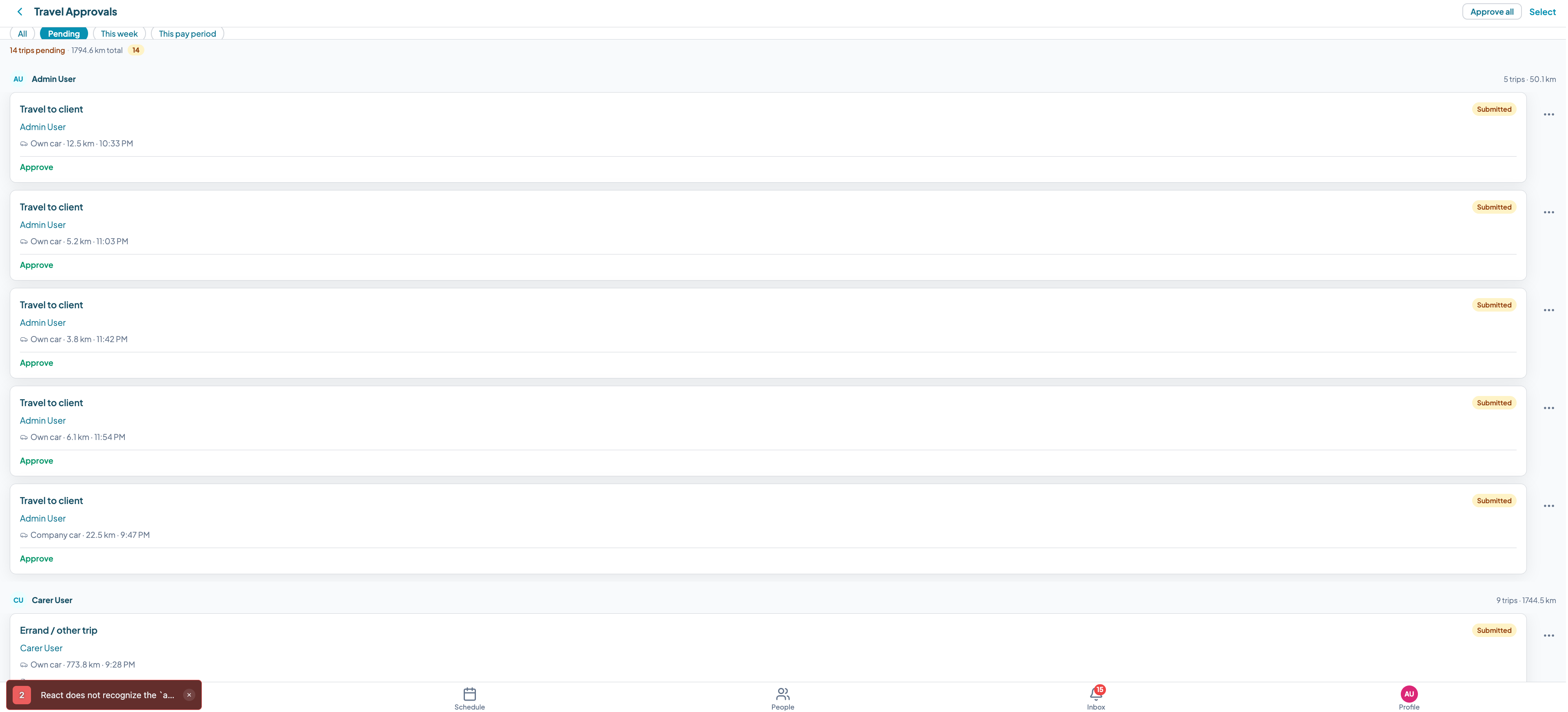
Coordinator approvals view in Teiro.
Why kilometre tracking matters for care providers
NDIS travel claims
NDIS Pricing Arrangements allow providers to claim two distinct types of travel costs. Provider travel time is billed at the support item rate, subject to time caps (generally 30 minutes in metropolitan areas, 60 minutes in rural/remote; check the current Pricing Arrangements). The per-km vehicle cost is claimed as a separate non-labour line item. When transporting a participant, kilometres are claimed against the participant's Core: Transport budget, not as provider travel. Providers with no structured km tracking often find claims rejected or underdocumented at audit. For aged care providers under the Support at Home program (from 1 July 2025), travel costs are typically managed within the participant's overall package budget rather than claimed per-kilometre.
SCHADS vehicle allowance
Workers who use their own vehicle to travel between clients during a shift are entitled to the vehicle allowance under the SCHADS Award (clause 20.3) at the current per-kilometre rate (check the Fair Work Pay Guide for the operative figure). Payroll teams cannot calculate this entitlement accurately without per-trip distance records. Organisations that estimate or skip this create both underpayment risk and Fair Work exposure.
Audit trail requirements
NDIS Quality and Safeguards Commission audits and SCHADS compliance reviews both require access to contemporaneous records. A kilometre log reconstructed from memory six months after the fact does not meet that bar. Records need to be captured at the time, linked to the shift, and accessible without a manual search.
Platform comparison
The table below reflects what each platform offers for kilometre tracking as of June 2026, based on publicly available product documentation. Features change; verify directly with each vendor before making a purchasing decision.
| Provider | Km tracking | Trip types | GPS distance | Approval workflow | Odometer capture |
|---|---|---|---|---|---|
| TeiroThis page | Yes, built into the carer mobile app | 3 types: Travel to client, Transporting client, Errand/other | GPS route calculation from current location, or manual entry | Dedicated approvals screen, individual and batch approval | Yes, optional photo capture per trip |
| ShiftCare | Basic kilometre logging available in mobile app | No structured trip-type workflow | No GPS route calculation | No dedicated km approval workflow or batch approval | No |
| CareMaster | Limited: manual log via notes or timesheets | Manual entry only, no structured trip types | No GPS calculation | No dedicated approval workflow | No |
| Brevity | No native kilometre tracking | Not applicable | Not applicable | Not applicable | Not applicable |
| FlowLogic | Partial: kilometre entry via timesheet module | Manual entry, no structured trip type categories | No GPS calculation | No dedicated km approval workflow | No |
| Lumary | No native kilometre tracking | Not applicable | Not applicable | Not applicable | Not applicable |
| Splose | Some travel expense tracking available | No structured trip-type categories | No GPS route calculation | No structured km approval workflow | No |
| GoodHuman | Limited: focused on participant/self-managed NDIS; km tracking not a core feature | No structured trip types | No GPS route calculation | No dedicated km approval workflow | No |
Information based on publicly available product documentation and user feedback as of June 2026. Features change; verify directly with each vendor.
What to look for in kilometre tracking software
1. Trip types, not just distances
Distance alone is not enough for NDIS claims. You need to know whether the trip was travel to the client, transport of the client, or an errand. Different trip types are treated differently for NDIS claiming purposes and may map to different support items depending on the participant's plan and agreement. They also attract different SCHADS entitlements. A kilometre log that captures only a number is not a claim record.
2. Logged at the time, not reconstructed later
The most defensible km records are captured immediately after the trip, while the carer is still parked. Systems that require end-of-week or end-of-fortnight data entry produce reconstructed records, not contemporaneous ones. Auditors notice the difference.
3. An approval workflow tied to payroll
Kilometres submitted by carers need a coordinator review step before they become claims or payroll inputs. Without a structured approval workflow, the process is either a rubber stamp or an unmanaged queue. Batch approval matters for coordinators processing fortnightly payroll runs across large teams.
4. Evidence capture for compliance
Odometer photos and receipt uploads are the documentation layer that makes claims defensible under audit. They do not need to be mandatory for every trip, but the system should support them when an organisation's policy requires them.
5. Linked to the shift and participant record
Kilometre records that exist in isolation from the shift and participant they belong to are hard to use for NDIS billing. The trip needs to trace back to a specific participant, a specific date, and a specific support item. A standalone kilometre app does not provide that linkage without manual cross-referencing.
See how Teiro logs and approves kilometres in detail, how that feeds into claim-ready NDIS invoicing, and how credential expiry alerts fits alongside it. Check our pricing page, or read a broader platform comparison in what competency tracking should actually mean.
See how Teiro handles kilometre tracking
Teiro is the only platform in this comparison with GPS route calculation, structured trip types, odometer photo capture, and a dedicated coordinator approval workflow with batch approval, all built directly into the carer app. Free for organisations with five or fewer active users.
Running a small team? Free for under 5 users - no credit card, no time limit.