
Overnight shifts
A record of the night, not a guess about it.
Designate a shift as a sleepover or an active night, and the rostered carer can log every wake-up on it: when it happened, how long it ran, what woke them, who they escalated to, and which resident it was about. One record per disruption.
Most providers have nothing here but a line in a communication book that says the night was disturbed. That sentence throws away the timestamps, the reasons and the pattern, which are the only parts anyone later needs.
Running a small team? Free for under 5 users - no credit card, no time limit.
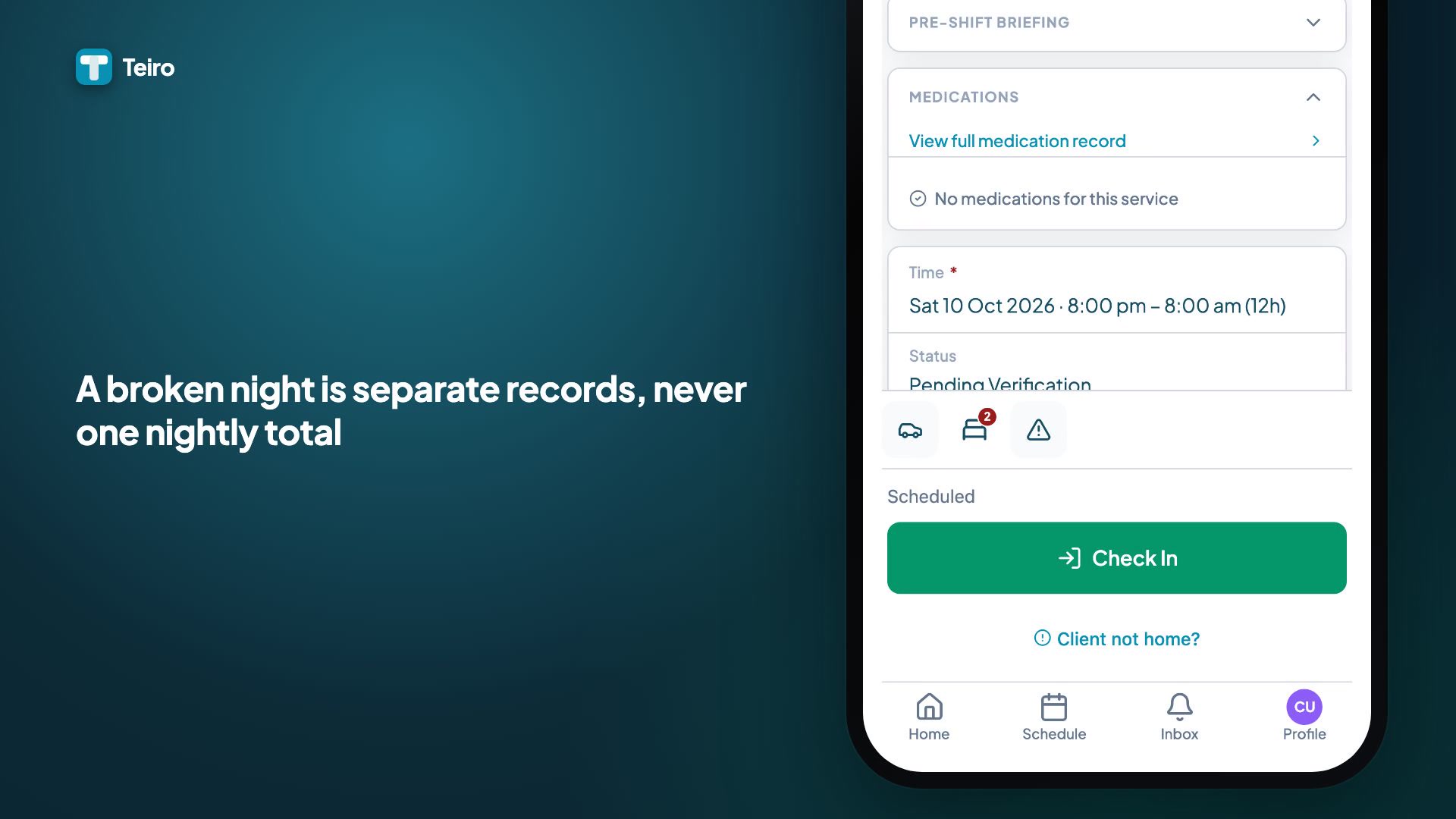
One record per wake-up, never a nightly total
Each disruption is its own record with its own start and end, its own reason, and its own escalation. You can always add records up afterwards. You can never split "90 minutes disrupted" back down into the wake-ups it came from, which is the one thing both the pay conversation and the clinical review need.
The action only exists on overnight shifts
A coordinator or scheduler designates the shift as a sleepover or an active night using the Overnight arrangement field. Only then does the carer see the bed icon to log a disruption. On an ordinary daytime visit the action is not there at all, so nobody logs broken sleep against a two-hour morning call.
Nine reasons, chosen so the pattern survives
Toileting, could not settle, repositioning, medication, behaviour, equipment, seizure, fall or acute illness, and other. "Could not settle" has its own place on purpose: without it, every client waking at 2am with no clinical trigger lands in Other, and a category that collects everything tells you nothing.
Which resident, not just which house
In a shared house a worker can be woken by any resident. The participant is pre-filled from the shift and stays editable, because logging one resident's episode against another is a clinical data problem, not an inconvenience. Blank is valid and means the night was about the house or the equipment, not one person.
Nothing works until the shift is designated
This is the part worth knowing before you go looking for the feature. The disruption log is not available on every shift. It appears only on shifts somebody has designated as an overnight arrangement, and a carer cannot do that designating.
That is a deliberate narrowing rather than an oversight. An action that shows up on all 400 shifts in a fortnight is an action that gets tapped on the wrong ones, and "log a disruption" on a one-hour morning call is not a thing anyone needs. Gating it on the designation also means the designation itself gets set, which matters a great deal more than the icon does: it is the field that says how the night is structured and paid.
If the bed icon is not on the shift
The Overnight arrangement field is blank. A coordinator, scheduler or admin sets it to Sleepover or Active night on the shift, or better, on the recurring pattern the shift came from, and the action appears for the carer. There is no org setting to turn on and nothing to install.
How it works
A coordinator designates the shift as an overnight arrangement
On the shift, the Overnight arrangement field offers two values: Sleepover (worker sleeps on site) or Active night (worker awake, paid hourly). It is not required and has no default, because it must be a deliberate decision rather than something guessed from the clock. An evening shift that happens to cross midnight is not a sleepover, and leaving the field blank is the right answer for it.
A carer cannot set it, and that is the point
Write access to that one field is limited to coordinator, scheduler and admin roles, separately from the rest of the shift. The designation is a pay and funding determination sitting on the same record as the carer's own disruption log, so a carer reclassifying their own sleepover as an active night is not something we leave available.
Set it once on a recurring pattern, not once per night
Nobody reopens a single Tuesday to tick a box. Designate the recurring pattern and every occurrence it produces inherits the value, with a per-occurrence override still available on any individual night. Where an NDIS service agreement already names a sleepover or active overnight support item, Teiro proposes the matching value when the shift is created, and says nothing at all when the agreement authorises both or neither.
The carer logs each wake-up from the shift
A bed icon appears in the action bar on the shift, next to Report Incident. Each tap creates one disruption: when it happened, how long it ran, the reason, who it was escalated to if anyone, an optional note, and which resident it concerned. The duration is worked out from the start and end on the server rather than taken on trust from the phone.
Written up in the morning, which is when it really happens
Carers reconstruct the night at 6:30am, not at 2am with the phone charging in another room, so the form is built for someone writing up a finished shift rather than logging live. The time field opens empty instead of guessing at today's date, because a plausible wrong default would corrupt both the pay figure and the clinical record. And a coordinator can enter one on a worker's behalf when they ring in the next day, with that attribution left visible on the record rather than hidden.
Nothing auto-approves
What comes out is a clean, timestamped, per wake-up account of the night that a person reviews. None of it approves itself. We made that call deliberately, because self-reported unwitnessed night-time hours are exactly the kind of record that should meet a human with the timestamps in front of them.
 0:26
Watch
How to Record a Disrupted Sleepover on an Overnight Shift in Teiro
A support worker logs two separate wake-ups on a 12 hour overnight shift with a sleepover period in the Teiro carer app, each with its own start time, end time and reason, so a broken night is recorded as separate records rather than one nightly total.
Watch the walkthrough
What woke the worker
The reason list is where most of the clinical value sits, so it is a vetted list rather than a free-text box. Escalation is a separate field: the reason is what woke the carer, the escalation is what they did next.
| Reason | Why it has its own category |
|---|---|
| Toileting or continence | The most frequent cause by a distance. A rising rate is often the first sign a continence review is due. |
| Could not settle | Very common, and frequently has no clinical trigger at all. Its own category, so the pattern does not vanish into Other. |
| Repositioning or comfort | Kept apart from toileting on purpose. Firing three times a night is the clearest sign the shift is classified wrong. |
| Medication or pain relief | Ties the night back to the medication record and to any pain management review. |
| Behaviour or distress | Feeds behaviour support planning instead of sitting in a progress note nobody aggregates. |
| Equipment or alarm | Often not a participant support need at all, which matters when you decide whether it is billable. |
| Seizure | Epilepsy is one of the main reasons overnight support is funded. A nocturnal seizure is not a fall and not a behaviour. |
| Fall, injury or acute illness | Merged deliberately. Nobody separates them at 3am, and a person on the floor is usually both. |
| Other | Requires a written note. If this one climbs past a small share of your records, the list is failing you and we want to know. |
Escalation options are None, On-call or coordinator, Nurse, GP or after-hours doctor, Ambulance, and Family or guardian.
A fall or a seizure is an incident first
Those two reasons exist because they are real causes of a wake-up, not because a disruption record is where they belong. A fall, an injury or a nocturnal seizure goes through your incident process with whatever escalation and reporting that triggers, and logging the wake-up does not discharge it. Report the incident as well. That is also why the disruption action uses a bed icon and sits beside Report Incident rather than looking like it.
The pay question is what gets you here. The care plan is why it matters.
A client woken most nights does not have a sleepover arrangement that is working. They have a support need being met at 2am by a worker whose job, on paper, is to be asleep and available. A dated run of wake-up records, each with a reason attached, is what turns that from a feeling the team has into something you can put in front of a support coordinator, a plan reassessment request or your own clinical governance review.
There is a clinical reading too. A new or worsening pattern of overnight waking is a change indicator: night-time toileting that was not there last month, repositioning becoming more frequent, someone who cannot settle and cannot say why. Both the NDIS and aged care quality frameworks expect a provider to identify a change in a person's needs and respond to it, and you cannot identify a pattern you never wrote down.
Three repositioning records a night, every night, is the clearest evidence you will get that the shift is classified wrong. Sleepover vs active night duty covers which classification applies, and disrupted sleepovers covers what the award and the funding do with a broken night, as distinct from what the software does with it.
What Teiro does not do here
There are no timesheets and no payroll file. There is no automatic path from a logged wake-up to a dollar figure. The calculation that would turn a night's worth of disruptions into what a worker is owed under your own rules is designed and scoped, and not built. What you get today is an accurate, structured, reviewed record that a person takes to the payroll system you already run.
We do not tell you what a wake-up is worth. That is decided by your enterprise agreement where one covers your workforce, and agreements can and do vary sleepover and broken rest provisions. Whether a minimum payment applies to each recall to duty or to the night as a whole is the single biggest variable in the cost of a broken night, and it is a question for your payroll or industrial relations adviser rather than a setting in a product.
A disruption is not a claim. What you pay and what you claim are two separate calculations off the same record, and a minimum payment is a payroll rule rather than support time that was delivered. The billable flag on each disruption is there so an equipment fault or a co-resident's episode is never treated as support delivered to a participant, but it is recorded for review today and does not generate a claim line on its own.
There is no write-up deadline we would call a requirement. Whatever window you run is your own documentation policy. Neither the NDIS Practice Standards nor the Aged Care Quality Standards is a source we would point at for a prescribed late entry deadline, so we are not going to present one to you as though it were.
Frequently asked questions
How does Teiro know a shift is a sleepover?
A coordinator, scheduler or admin tells it, using the Overnight arrangement field on the shift. The two values are Sleepover (worker sleeps on site) and Active night (worker awake, paid hourly). It is never inferred from the shift time, because a late evening shift that crosses midnight is not a sleepover and the distinction is a pay and funding one rather than a time-of-day one. Setting it on a recurring pattern carries it to every occurrence that pattern produces.
Can a support worker log a disruption on any shift?
No. The action appears only on shifts a coordinator has designated as a sleepover or an active night. On an ordinary daytime visit it does not exist. A carer can create and read disruptions on an overnight shift they are rostered to, but cannot change the overnight designation itself, because that field decides how the night is paid and claimed.
Does Teiro calculate what the worker is owed for a disrupted night?
No, and we would rather say so plainly. Teiro has no timesheets and produces no payroll file. What it gives you is an accurate per wake-up record of the night, with times, reasons and escalations, reviewed by a person and then taken to whatever payroll system you already run. The calculation that would turn a set of wake-ups into a figure under your own agreement is designed and scoped but not built.
Is a logged disruption the same as a claim?
No. What you pay and what you claim are two different calculations off the same record, and a minimum payment under an industrial instrument is a payroll rule that does not create support time that was delivered. Each disruption carries a billable flag so that an equipment fault or a co-resident's episode is never treated as support delivered to a participant, but that flag is recorded for review today. It does not yet generate a claim line by itself.
What happens if the wake-up was a fall or a seizure?
It goes through your incident process, with whatever escalation and reporting that triggers. Fall, injury or acute illness and Seizure are reasons on the disruption record because they are real causes of a wake-up, but recording the wake-up does not discharge the incident process and is not a substitute for it. Report the incident as well.
What if the worker forgot to log it and rings in the next morning?
A coordinator can enter the disruption on the worker's behalf, and that attribution stays visible on the record rather than being presented as the worker's own entry. This is a normal thing to have to do, so the product treats it as normal rather than as an exception to work around.
Related features and guides
Overnight work touches rostering, incidents and the award. These cover the rest of it.
Disrupted sleepovers: what the award and the funding do
The other half of this page. Why a nightly total is the wrong record, what your enterprise agreement decides, and how pay and claiming come apart.
Sleepover vs active night duty
Which classification applies before you designate anything, and what each one costs.
Incident reporting
Where a wake-up stops being a disruption and becomes a reportable incident.
Rostering and the scheduling board
Building the recurring overnight pattern the designation is set on.
SIL rostering and overnight shift costs
Building a compliant 24/7 roster, including the cost difference between a sleepover and a waking night.
Client records and progress notes
Where the pattern of overnight waking sits alongside the rest of the clinical record.
See a disrupted night recorded properly
We will walk through designating an overnight shift, what the carer sees on it, and the record a coordinator reviews the next morning.
Free for under 5 users - no credit card, no time limit.