
A common overnight arrangement looks like this. A twelve-hour shift, built as four hours of active support, an eight-hour sleepover, then four more hours of active support. Some services pay an hour of active time within the sleepover regardless of what happens on the night, and where the disruption runs past that, the extra goes at the hourly rate, rounded up. The question that follows is almost always the same: can any of it be semi-automated, a tick on a timesheet, or something like it.
If you run overnight support you already recognise the shape of that shift. One worker, one long night, and one genuinely difficult thing to pay and record accurately.
Most providers answer this the same way: a paper communication book on the fridge, or a line in a progress note the next morning that says something like "disturbed night, up a few times". That is not a criticism. It is what happens when there is no structured place to put the information and the person writing it down is doing so at 6:30am after being woken three times.
The trouble is that one sentence in a progress note throws away almost everything that matters.
This is a care planning problem before it is a payroll problem
The pay run is not the only thing a wake-up record is good for.
Every disruption Teiro records carries a time, a duration and a reason, so a run of nights becomes something you can actually look at. How often this client is woken, at what hours, and for what. That view does not exist if the night is summarised as a line in a progress note, and it is the view you want in front of you when the arrangement comes up for discussion.
Because each reason is a separate field rather than free text, the pattern is something you can filter and count. Night-time toileting that was not there last month, repositioning that is becoming more frequent, someone who cannot settle: these read as a trend in Teiro rather than as nine months of individual notes somebody would have to sit and re-read.
When the arrangement is reviewed, that is what you bring: a dated record of every wake-up with a reason attached, rather than a recollection that the nights have been hard lately.
The claiming side most providers cannot see
It is easy to think about disrupted nights purely as money you owe a worker. This section is written with NDIS overnight supports in mind. The claiming side works differently again under aged care funding.
The NDIS price guide prices a sleepover item to cover the sleepover period including a limited amount of active support within it. Where active support during the night goes beyond that included amount, the price guide provides for the additional time to be claimed separately at the relevant hourly rate. We are not putting a number on the included amount here: it is set by the NDIS Pricing Arrangements and Price Limits, that document is reissued regularly, and before you rely on any of it you need the current edition in front of you, budget in the participant's plan, and a service agreement that covers it.
The practical consequence is simple. You can only claim accurately for a night you can describe accurately. If nobody records what actually happened overnight, the same gap that risks underpaying the worker also leaves you unable to substantiate a claim you might have been entitled to make, or to defend one you did.
Why "rounded up" is the part to be careful with
Their arrangement contains a detail worth sitting with: one hour of active time paid regardless, and anything over that paid at the hourly rate, rounded up.
That is a perfectly reasonable policy to run. But notice what it assumes: that what matters is the total disrupted time across the whole night. Some agreements do not work that way. They apply a minimum payment to each recall to duty, rather than to the night as a whole. If that is how yours reads, three twenty-minute wake-ups and one sixty-minute wake-up are the same total time but not the same amount owed, because each separate recall may attract its own minimum.
One thing worth separating, because it is easy to run them together. What you pay and what you claim are two different calculations off the same record. A minimum payment is a payroll rule. It does not create support time that was delivered. If a twenty-minute recall attracts a one-hour minimum payment under your agreement, you have paid for an hour and delivered twenty minutes, and only one of those numbers belongs in a claim.
| The night | Total disrupted | Minimum payments triggered |
|---|---|---|
| Three wake-ups of 20 minutes | 60 minutes | Three, if your agreement applies a minimum per recall |
| One wake-up of 60 minutes | 60 minutes | One |
You cannot tell those two nights apart from a single number like "90 minutes disrupted". You can only tell them apart if each wake-up was recorded separately with its own start and end. You can always add records up. You can never split a total back down.
This is also why the difference is worth getting right rather than estimating. Where an agreement does apply a minimum per recall, the gap on a broken night is a multiple, not a rounding, and an underpayment has years of reach behind it.
Check your enterprise agreement before you standardise anything
We are deliberately not quoting a clause number, a dollar figure or a percentage on this page. Enterprise agreements can and do vary sleepover and broken rest provisions, and where an agreement covers your workforce it rather than the award is usually the operative rule. If you do not already know which way yours reads on per recall versus per night, that is a question for your payroll or industrial relations adviser rather than a guess. A note that says "90 minutes" has already thrown the answer away.
What a usable wake-up record contains
Four things, per wake-up. When it started and when it ended. What woke the worker. What they did about it, if they escalated to anyone. And which resident it was, because in a house with several residents a worker can be woken by any of them and logging resident B's episode against resident A is a clinical data problem, not a convenience one.
The reason list is where most of the care planning value is, and it is worth being opinionated about it. A list that funnels half of all records into "Other" destroys the signal the record exists for.
| Reason | Why it earns its own category |
|---|---|
| Toileting or continence | The highest frequency cause. A rising rate is often the first sign of a continence review being due. |
| Could not settle | Extremely common and frequently has no clinical trigger. Without its own category it lands in Other and the pattern disappears. |
| Repositioning or comfort | Kept separate from toileting on purpose. Three repositionings a night is the clearest signal that the shift is classified wrong. |
| Medication or pain relief | Links the night to the medication record and to any pain management review. |
| Behaviour or distress | Feeds behaviour support planning rather than sitting in a progress note nobody aggregates. |
| Equipment or alarm | Often not a participant support need at all. Worth separating so it is not claimed against a plan. |
| Seizure | Epilepsy is a primary reason overnight support is funded. A nocturnal seizure is not a fall and not a behaviour. |
| Fall, injury or acute illness | Merged deliberately. Nobody distinguishes them at 3am, and a person on the floor is usually both. |
| Other | Requires a written note. If this one climbs past a small share of your records, the taxonomy is failing you. |
Escalation is a separate field, not a reason. The reason is what woke the worker. The escalation is what they did next.
Some reasons are more than a disruption. A fall or a seizure overnight is an incident first and a payroll line second: it goes through your incident process with whatever escalation and reporting that triggers, and recording the wake-up does not discharge that.
When it gets written up
Carers reconstruct the night at 6:30am. They do not log at 2am with the phone charging in another room, and a system that assumes they will is a system that collects nothing.
So the window to write it up should run from the end of the shift and should be generous. There is no deadline here that we would present to you as a regulatory requirement. Whatever window you run is your own documentation policy. Tightening it adds no integrity that a review step does not already provide, and the error costs are lopsided: an exaggerated record meets a reviewer with the timestamps in front of them and costs a conversation, while a lost record is an underpayment with years of reach.
It also needs to survive the worker ringing in the next morning to say they forgot. A coordinator should be able to enter it on their behalf, with that attribution visible on the record rather than hidden.
So can it be semi-automated? Honestly, partly
That was the actual question, so here is a straight answer about what Teiro does and does not do.
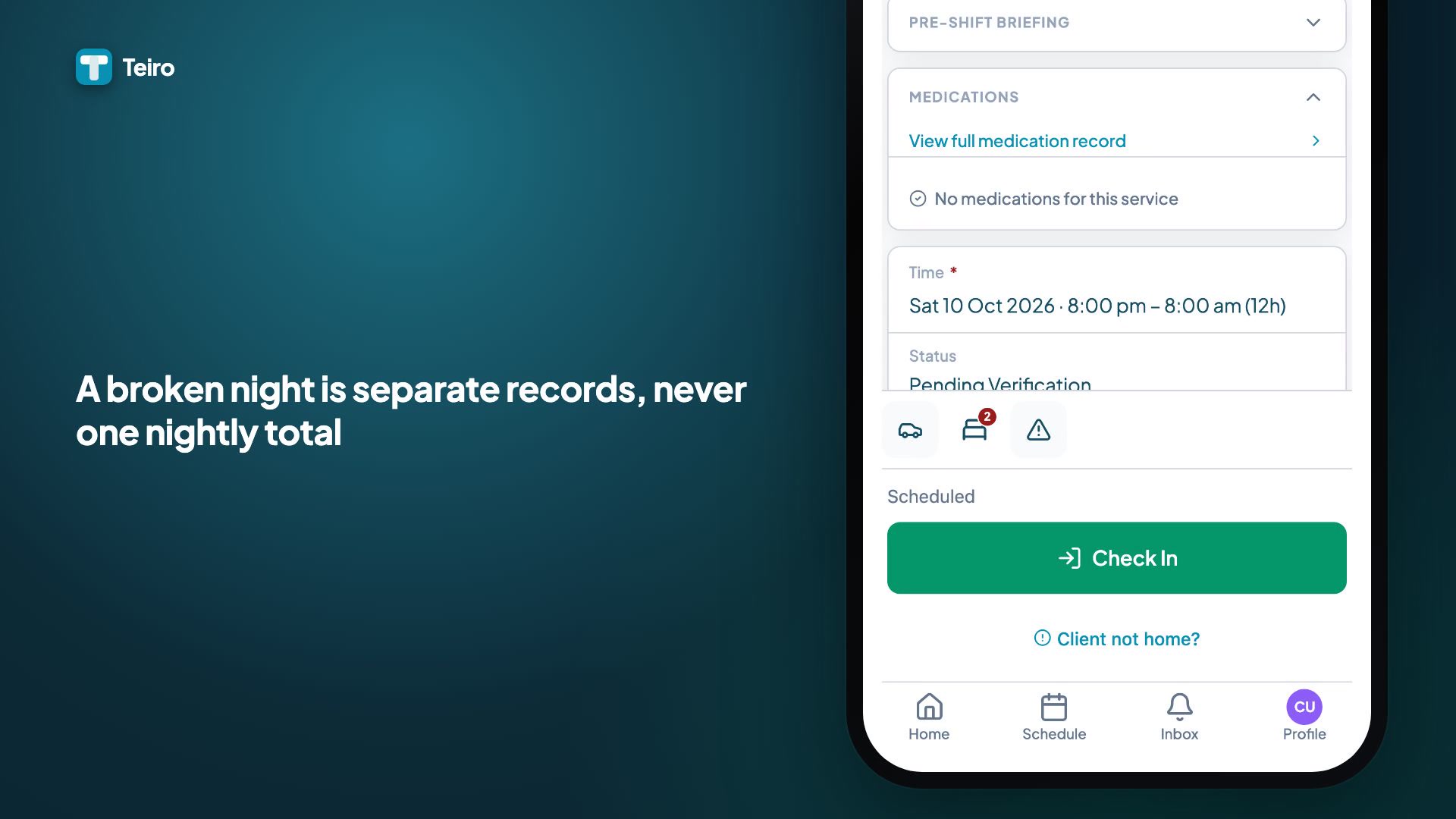
What exists today solves the recording problem, and the overnight shifts feature page walks through it in detail. On a shift designated as overnight, and only on those shifts, the carer gets an action to log a disruption. Each one is its own record with its own start and end, a reason from the list above, an optional escalation and a note. A coordinator can log one on a worker's behalf, and that is attributed honestly rather than presented as the worker's own entry. What comes out is a clean, timestamped, per wake-up record of the night that a person can review.
 0:26
Watch
How to Record a Disrupted Sleepover on an Overnight Shift in Teiro
A support worker logs two separate wake-ups on a 12 hour overnight shift with a sleepover period in the Teiro carer app, each with its own start time, end time and reason, so a broken night is recorded as separate records rather than one nightly total.
Watch the walkthrough
None of it auto-approves. We made that call deliberately, because self-reported unwitnessed night-time hours are exactly the kind of record that should meet a human with the timestamps in front of them before anything is done with it.
What it does not do
Teiro has no timesheets and produces no payroll file. There is no automatic path from a logged wake-up to a dollar figure, because the calculation that would turn a batch of wake-ups into what a worker is owed under your specific rules is designed and scoped but not built.
If you are running the arrangement described above today, the honest answer is that you get an accurate, structured, per wake-up record of what happened, reviewed before it goes anywhere near payroll. The one click "and here is the dollar figure" step is next, not now.
That is still a long way ahead of a line in a communication book saying "disturbed night". It is the difference between remembering roughly what happened and being able to show exactly what happened, which is what the worker, the client and your claim all need you to have.
One thing to settle first
Everything on this page assumes the shift is correctly classified as a sleepover in the first place. If a client needs regular intervention through the night, it is not a sleepover at all and no amount of careful disruption recording will fix that. Sleepover vs active night duty covers which classification applies and what each one costs. Come back here once you know the answer is sleepover. In fact, a disruption log that fires three times a night, every night, is usually the evidence that sends you back to that page.