
Running visits without check-in and check-out
How to turn off check-in and check-out in Teiro, what changes for your workers, and what you take on instead. Often used by care companies working with subcontractors.
Check-in and check-out give coordinators a real-time attendance record: an actual start time, an actual end time, and GPS confirmation the worker was there. It's on for every organisation by default. Not every provider wants that level of tracking on every worker, and Teiro doesn't require it.
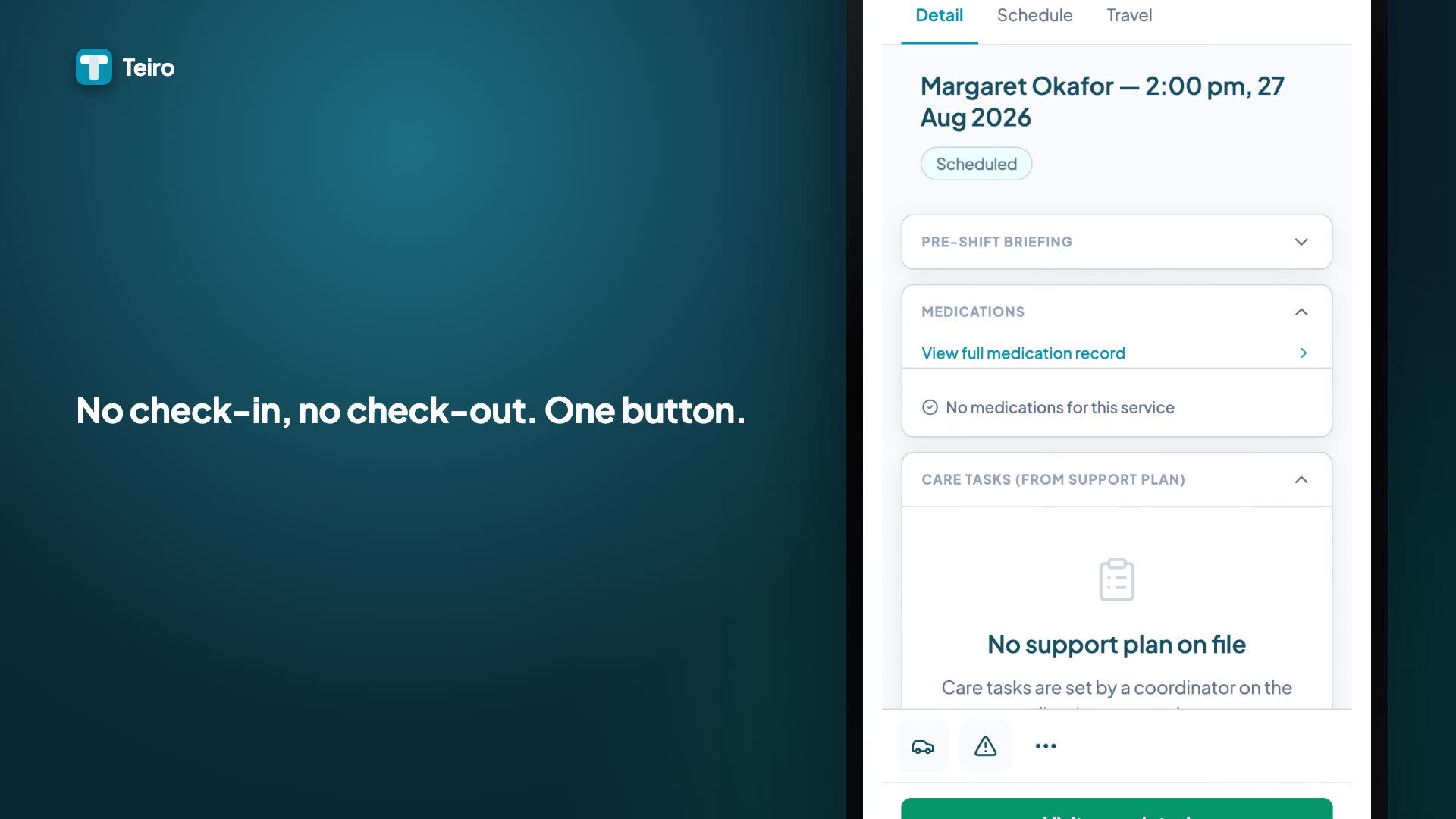
Turn check-in and check-out off, and workers mark a visit completed instead, adding notes afterward.
Watch the walkthrough
 0:48
0:48Watch
How to Run Visits Without Check-In and Check-Out in Teiro
An admin turns off check-in and check-out for visits in Org Settings. A worker then opens today's visit and marks it completed with a single button instead of separate check-in and check-out steps, adding a note afterward.
Watch the walkthrough
Where to find it
- 1.Tap your profile at the bottom of the app.
- 2.Choose Org Settings (the row with the gear icon, under Organisation Settings).
- 3.Scroll to the VISITS section.
- 4.Turn off Require check-in and check-out.
This is admin-only, and it applies to the whole organisation. It is on by default.
What changes when it's off
- Instead of separate check-in and check-out steps, the worker sees a single Visit completed button on the visit. There's no timer, no GPS capture, and no offline check-in queue to sync.
- Notes are written after the visit is marked completed, not as part of a check-in or check-out step. The notes section itself doesn't change.
- Client not home? is still there. That's a welfare-reporting action, not a check-in step, so it stays available either way.
- Missed check-in alerts, and the SMS that would otherwise chase a worker who hasn't checked in, stop for your organisation -- there's no check-in event left for either to fire against.
That last point cuts both ways. It removes a form of real-time chasing that some providers would rather not apply to their workers, but it also removes Teiro's only automated way of telling you a visit didn't happen as planned. For clients who'll flag it themselves if a worker doesn't show, or where a missed visit is obvious quickly, that's a reasonable trade. For clients who can't reliably self-report, you'll want another way of knowing a visit actually happened, since Teiro won't be the one to tell you.
This is an organisation-wide setting
It isn't set per worker. Turn it off and it's off for everyone rostered through Teiro, including any employees or in-house coordinators on your team, not just your subcontractors. Most small providers running subcontractors still have at least one or two people they employ directly, and for them, check-in and check-out is often exactly the attendance record you want -- for their own timesheets and for general oversight. Worth weighing before you switch it off across the board.
What you take on instead
Claim quantities. When there's no recorded check-in or check-out time for a visit, Teiro works out the claim quantity from the visit's scheduled start and end time rather than holding the claim for missing attendance evidence. With this setting off, that's true of every visit, not just the odd one where a check-in was missed.
That's a statement about how Teiro calculates the number, not about what you're entitled to claim. You're still responsible for claiming only the supports actually delivered. If a visit runs shorter than scheduled, longer than scheduled, or doesn't happen at all, Teiro has no independent attendance record in this mode to catch that for you -- you need another way to know. Decide upfront how you'll get that evidence when you need it: the worker's own record of their time, your own arrangement with the subcontractor for how they report back, or however you'd otherwise verify a contractor's invoice.
Branches and head office
If your organisation has a head office and branch structure, this setting is inherited one level down: set it on the head office and branches pick it up automatically, unless a branch has explicitly set its own value. A branch can still override it.
Who runs visits this way
Care companies working with subcontractors often prefer to run things like this, and some providers simply do not want that level of tracking on every worker. Either way, it is your call how you run it.
Filling shifts without rostering someone directly
Turning off check-in doesn't change how a shift gets assigned in the first place -- someone still needs to decide who does the work. If the people you work with pick up shifts rather than being rostered onto them, offering a shift and letting someone accept it will fit your day-to-day better than assigning it directly.
Teiro can offer an unassigned service to a tier of eligible carers instead of assigning one directly: the client's regular team, their preferred carers, or anyone eligible. You see how many carers are actually eligible before the offer goes out, and once someone accepts, you assign it. See Offering an unassigned service to your team for the full walkthrough.
Frequently asked questions
Does this affect existing visits, or only new ones? It applies going forward. Visits that already have a check-in or check-out recorded aren't changed.
Will incident reporting still work? Yes. Incident reporting isn't part of the check-in/check-out flow and isn't affected by this setting.
Ready to see it on your own team? Book a demo or start free for up to five active users.
Related articles
Checking in and out of a job
How carers check in at the start of a visit and check out when they leave.
Carer app overview
Everything carers can do in the Teiro mobile app — jobs, check-ins, incidents, and more.
Offering an unassigned service to your team
How to offer an unassigned service to a tier of eligible carers instead of assigning one directly or ringing around, where to find the button, and why the default tier can look empty for a new client.
Submitting incident reports
Report incidents, near misses, or safeguarding concerns directly from the app.